
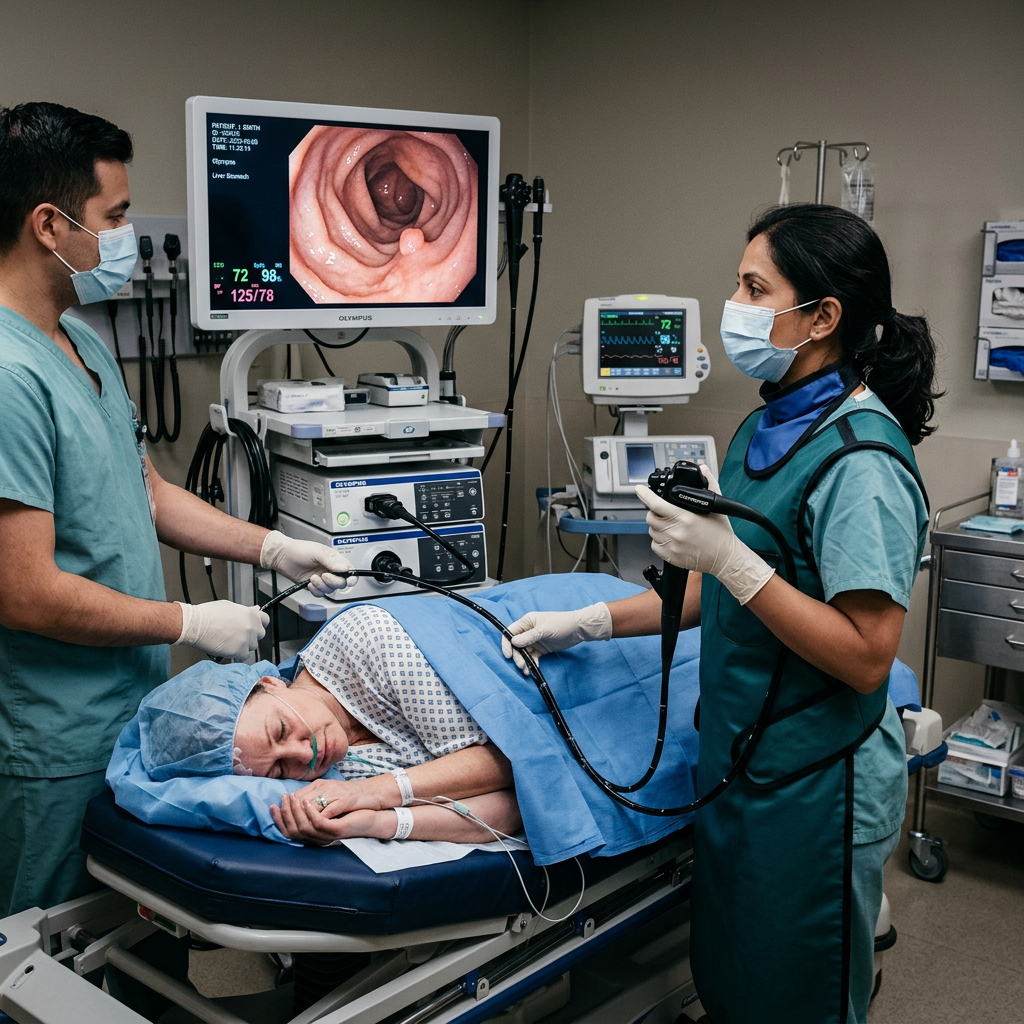
An endoscopy is a medical test that lets doctors look inside your body using a thin, flexible tube with a camera on the end, called an endoscope. It’s used to investigate symptoms, diagnose conditions, and sometimes even treat problems without surgery.
🩺 What an endoscopy does (in simple terms)
- A long, thin tube with a light and camera is gently passed into the body through a natural opening (mouth, nose, or bottom)
- The camera sends live images to a screen so the doctor can see what’s going on inside
- Tools can also be passed through the tube to take biopsies, stop bleeding, or remove small growths
Harvard Health
Credible health information source
Upper endoscopy (esophagogastroduodenoscopy or EGD)
This test inspects your esophagus, stomach, and the first section of intestine (the duodenum) using an endoscope. An upper endoscopy allows the doctor to explore the cause of such symptoms as difficulty swallowing, abdominal pain, vomiting up blood, or passing blood in the stool. It can also diagnose irritation, ulcers, and cancers of the lining of the esophagus and stomach. During this type of endoscopy, the doctor can also take biopsy samples of tissue.See more
🔍 What it’s used for
According to the NHS, endoscopy is used to look inside areas such as the oesophagus, stomach, bowel, bladder, womb, lungs, and more. It helps diagnose things like:
- Difficulty swallowing
- Stomach pain or indigestion
- Bleeding
- Anaemia
- Suspected cancer
🧪 Common types of endoscopy
Different names are used depending on the part of the body being examined:
- Gastroscopy / Upper endoscopy (EGD) – through the mouth to look at the oesophagus, stomach, and upper small intestine
- Colonoscopy – through the bottom to look at the large bowel
- Bronchoscopy – into the lungs
- Cystoscopy – into the bladder
- Hysteroscopy – into the womb
⏱️ How long it takes
Most endoscopies take 30 minutes to 2 hours, depending on the type.
😌 Does it hurt?
You’re usually given sedation or local anaesthetic, so you shouldn’t feel pain—maybe just pressure or mild discomfort.
If you want, I can also explain:
- The difference between endoscopy and colonoscopy
- What happens before or after the procedure
- What type you might need based on symptoms
Would you like a simple explanation, or more detail?
 Christian Devotions, Health and General issues of the day