Re blog – Edward Elgar

This morning I bring to you a blog with a difference.

The story of the Enigma Variations is an amusing one. Tired from a day of giving violin lessons, Elgar returned home to improvise a theme on the piano. His wife liked it and he comically tried to imagine how some of their musical friends may play the piece instead, hence the proper title of Variations on an Original Theme (Enigma) Op 36.

The collected pieces were known as Engima for two reasons. The first puzzle inside it is to tie the likely personalities to the variations, a game which Elgar himself gave away when he wrote some notes for (of all things) a pianola roll version of his music. The second puzzle contained in the music is far more subtle, and concerns a musical link that ties all the variations together. Elgar himself said that the theme is never actually heard and that the element that links the pieces is of the ‘slightest texture’ and therefore that ‘the chief character is never on stage’. Elgar never gave the game away about the identity of the piece and took the solution to his grave in St Wulstan’s Catholic Church in Little Malvern in 1934. He actually thought any suitably educated person would solve it on hearing the first performance. No one did, and no one has.

Others have wished the theme to be more obvious than all of this and have suggested that the musical link is anything from God Save the Queen, through Auld Lang Syne and (more promisingly) Bach’s The Art of the Fugue. Others have taken a more tortuous look at things and have suggested that the theme is in fact a reflection of Elgar’s own Christian faith, particularly in the context of some wordplay concerning biblical quotations. No one is ever going to know for certain and that, to me, is appealing.

The ninth variation was given the name ‘Nimrod’ after the biblical reference to Noah’s great-grandson of the same name who was a gifted hunter. It pays tribute to Elgar’s great friend Augustus J Jaeger (whose surname in German translates to ‘Hunter’) who managed to keep Sir Edward’s hopes up while he was still trying to make his mark on the world of music. Elgar attempted to capture Jaeger’s nobility in the slowness of the piece and (allegedly) tried to make a musical reproduction of a a conversation they once had late at night concerning the slow movements of Beethoven’s slow pieces. Indeed, the first few bars closely resemble the very start of the second movement of Beethoven’s Eighth Piano Sonata (also called Pathetique). Having said that, the piece also quotes from Mendelssohn at one point as well.

Perhaps it’s due to the fact that the piece is always played at the Cenotaph on Rememberance Sundays that this piece of music captures – maybe more than even his celebrated Pomp and Circumstance – the essence of Britishness in a few pithy musical phrases. Jaeger’s personal nobility aside, its slowness and languid fluidity seems to speak of stoical endurance, making do, fighting to the last bullet and of a small ‘c’ variery of conservatism that the sceptred isle will probably never shake off as long as we exist.

As for the music, I’ve loved this one variation above all the others since I was a child. Like everyone else I probably know it best from a muted brass band playing it on some Sunday every November, but the orchestral version offers so much more. The music appears to climb endlessly, like some kind of Escher staircase (or Shepard tone), playing with cadence, crescendo, tension and release in the most masterful of ways.

Jonathan Scott playing Elgar’s Nimrod on the largest organ in the world

What Is a Born Again Christian?

The phrase “Born Again Christian” applies to people who have accepted Jesus as their Saviour or Redeemer. To be born again in this sense is not an actual physical rebirth, but it indicates a spiritual rebirth.

The phrase “born again Christian” is frequently misinterpreted. Looking at its primary reference, we see that its meaning is not about physical birth, but about experiencing a spiritual renewal. It is is an expression used by many Protestants to define the moment or process of fully accepting faith in Jesus Christ. It is an experience when the teachings of Christianity and Jesus become real, and the “born again” acquire a personal relationship with God.

The term is originated from an incident in the New Testament in which the words of Jesus were not understood by a Jewish Pharisee, Nicodemus.

Jesus replied, “Very truly I tell you, no one can see the kingdom of God unless they are born again.” “How can someone be born when they are old?” Nicodemus asked. “Surely they cannot enter a second time into their mother’s womb to be born!” Jesus answered, “Very truly I tell you, no one can enter the kingdom of God unless they are born of water and the Spirit.” John 3:3-5 NIV

How to be Born Again

The phrase “born again” applies to people who have accepted Jesus as their Saviour or Redeemer. The born again soul realizes that they are a sinner (Romans 3:23) and that the penalty for that sin is death (Romans 6:23). To rectify the circumstances, God sent His only Son to die in their place, to take the punishment for sin (Romans 5:8). After Jesus’ death, He arose from the dead (1 Corinthians 15:3-6). Jesus is the only way to God (John 14:6) and He provides the blessing of salvation. Each person has the choice to receive or reject God’s gift through faith (Ephesians 2:8-9) and experience new birth (John 3:1-8). Whoever follows Jesus as Christ, the Son of God, and has accepted His gift of life can be called Christian. That is where the journey of rebirth begins. 

Being born again is having a change or transformation of the soul and heart by the work of God’s Spirit. One’s soul is the part of our being that consist of three things: the mind (or its disposition), emotions (feelings), and our will (what we determine). 

This spiritual makeover when we become a born again Christian is a change in the way we think, the way we manage our emotions, and choices we make by our will.

Mind

“And he who searches our hearts knows the mind of the Spirit, because the Spirit intercedes for God’s people in accordance with the will of God” (Romans 8:27). 

“Do not conform to the pattern of this world, but be transformed by the renewing of your mind. Then you will be able to test and approve what God’s will is—his good, pleasing and perfect will” (Romans 12:2).

“‘Who has known the mind of the Lord so as to instruct him?’ But we have the mind of Christ” (1 Corinthians 2:16).

Through being born again, renewing our minds, and having an intimate relationship with God, we grow by spending time in His presence and in His Word (the Bible). Though we cannot fully comprehend God, His Spirit lives in us, giving us a profound understanding of Him and His ways. 

Emotions

“Do not let any unwholesome talk come out of your mouths, but only what is helpful for building others up according to their needs, that it may benefit those who listen. Get rid of all bitterness, rage, and anger, brawling and slander, along with every form of malice” (Ephesians 4:29, 31). 

Born again Christians are not to let their emotions control their behavior. Philippians 4:6 says “Do not be anxious about anything, but in every situation, by prayer and petition, with thanksgiving, present your requests to God.” In Him we have peace. 

Being led by God

Psalm 16 New International Version

Psalm 16

Photo by Pixabay on Pexels.com

A miktam[a] of David.

Keep me safe, my God,
    for in you I take refuge.

I say to the Lord, “You are my Lord;
    apart from you I have no good thing.”
I say of the holy people who are in the land,
    “They are the noble ones in whom is all my delight.”
Those who run after other gods will suffer more and more.
    I will not pour out libations of blood to such gods
    or take up their names on my lips.

Lord, you alone are my portion and my cup;
    you make my lot secure.
The boundary lines have fallen for me in pleasant places;
    surely I have a delightful inheritance.
I will praise the Lord, who counsels me;
    even at night my heart instructs me.
I keep my eyes always on the Lord.
    With him at my right hand, I will not be shaken.

Therefore my heart is glad and my tongue rejoices;
    my body also will rest secure,
10 because you will not abandon me to the realm of the dead,
    nor will you let your faithful[b] one see decay.
11 You make known to me the path of life;
    you will fill me with joy in your presence,
    with eternal pleasures at your right hand.

  1. He leadeth me, O blessed thought!
    O words with heav’nly comfort fraught!
    Whate’er I do, where’er I be
    Still ’tis God’s hand that leadeth me.
    1. Refrain:
      He leadeth me, He leadeth me,
      By His own hand He leadeth me;
      His faithful foll’wer I would be,
      For by His hand He leadeth me.
  2. Sometimes ’mid scenes of deepest gloom,
    Sometimes where Eden’s bowers bloom,
    By waters still, o’er troubled sea,
    Still ’tis His hand that leadeth me.
  3. Lord, I would place my hand in Thine,
    Nor ever murmur nor repine;
    Content, whatever lot I see,
    Since ’tis my God that leadeth me.
  4. And when my task on earth is done,
    When by Thy grace the vict’ry’s won,
    E’en death’s cold wave I will not flee,
    Since God through Jordan leadeth me.

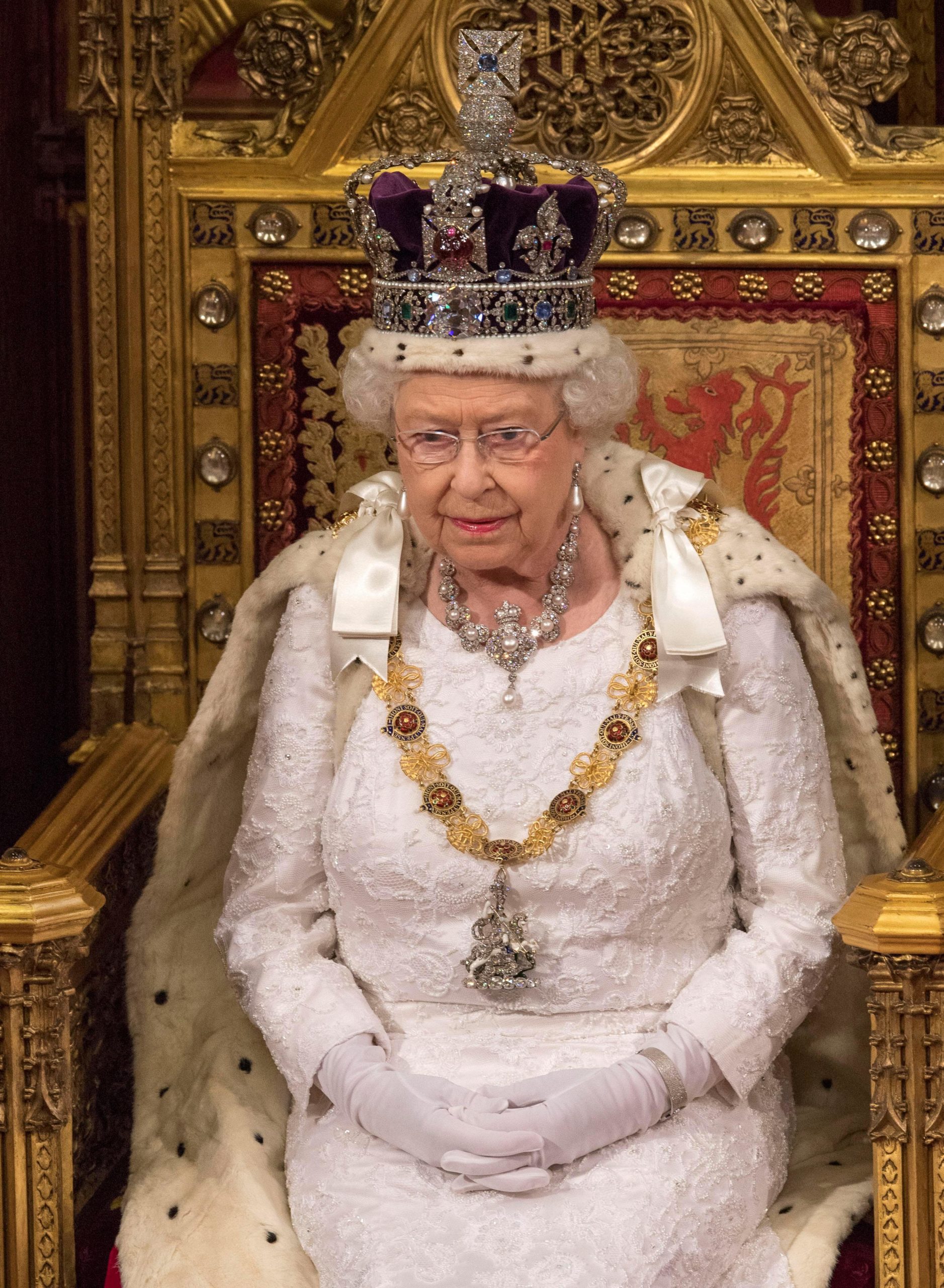
Queen Elizabeth dies at 96

Kenneth's avatarBrain disorders & other General topics of the day

BALMORAL, Scotland, Sept 8 – Queen Elizabeth, Britain’s longest-reigning monarch, the nation’s figurehead and a towering presence on the world stage for seven decades, died peacefully at her home in Scotland on Thursday aged 96.

“The death of my beloved Mother, Her Majesty The Queen, is a moment of the greatest sadness for me and all members of my family,” the new king, her eldest son Charles, said.

“I know her loss will be deeply felt throughout the country, the Realms and the Commonwealth, and by countless people around the world,” the 73-year-old said in a statement.

News that the queen’s health was deteriorating emerged shortly after midday on Thursday when her doctors said she was under medical supervision, prompting her family to rush to Balmoral Castle in Scotland to be by her side.

Thousands gathered outside Buckingham Palace, in central London, and there was a stunned silence when the…

View original post 33 more words

Just where he needs me

Galatians 6 New International Version 

Doing Good to All

Brothers and sisters, if someone is caught in a sin, you who live by the Spirit should restore that person gently. But watch yourselves, or you also may be tempted. Carry each other’s burdens, and in this way you will fulfill the law of Christ. If anyone thinks they are something when they are not, they deceive themselves. Each one should test their own actions. Then they can take pride in themselves alone, without comparing themselves to someone else, for each one should carry their own load. Nevertheless, the one who receives instruction in the word should share all good things with their instructor.

Do not be deceived: God cannot be mocked. A man reaps what he sows. Whoever sows to please their flesh, from the flesh will reap destruction; whoever sows to please the Spirit, from the Spirit will reap eternal life. Let us not become weary in doing good, for at the proper time we will reap a harvest if we do not give up. 10 Therefore, as we have opportunity, let us do good to all people, especially to those who belong to the family of believers.

Andrew Mair a Salvationist and composer of music with The Salvation Army composed the following tune to the hymn/song “Just where he needs me”. He speaks a little about his musical background and the Salvationist musicians/composers that inspired him.

The Lily of the Valley

The Song of Solomon is an extended love poem. In Song of Solomon 2:1, the woman declares, “I am a rose of Sharon, a lily of the valleys.” Then the man affirms in verse 2, “Like a lily among thorns is my darling among the young women.” Then in verse 3 the woman responds, “Like an apple tree among the trees of the forest is my beloved among the young men.”

In the first verse, the woman says she is a rose of Sharon and a lily of the valleys. Many different plants have been called a rose of Sharon, and we do not know the specific species that is referred to here. There is also some question as to how the lily of the valley is to be identified. Suggestions include wild-growing anemone, hyacinth, tulip, iris, and gladiolus. In any case, the lily of the valley was a beautiful and fragrant plant. In the context of Song of Solomon, it may be that the woman is comparing herself to some common wildflowers that would not necessarily be considered valuable or beautiful when compared to cultivated flowers.

On the contrary, the man sees his beloved as a lily among thorns. Thorns are ugly, unattractive, and uninviting. But his beloved is a lily among the thorns—she stands out in his eyes, and her beauty outshines that of all other women. By the same token, the woman sees her bridegroom as an apple tree among the other trees in the forest—he is unique and valuable in her eyes.

The point seems to be that each lover finds the other superior to all the other options. The bride is a lily, as compared to thorns. The bridegroom is an apple tree, as compared to the other forest trees. There might be a lot of trees in the forest that are large and tall—like the mighty oak or the cedar of Lebanon. A rather small, scrubby apple tree would not seem to be very significant by comparison. However, when one considers the fruit that the apple tree gives, it is extraordinary. A person might chop down any number of trees for firewood, lumber, etc., but would most likely save an apple tree because of the fruit.

The point seems to be that comparing a beloved with others is all a matter of perspective. A lily of the valley compared to cultivated flowers might be rather insignificant, but compared to thorns that grow around it, it is beautiful. An apple tree is not the greatest tree in the forest, but when you consider the fruit that it gives, it is a wonderful tree.

This is the attitude that married people need to have when viewing each other. Each spouse needs to emphasize the positive strengths of the other. If one spouse looks around and starts to compare himself/herself against others who are better looking, more successful, richer, more powerful, more talented, more capable, etc., he or she may begin to feel inadequate or unworthy. It is the responsibility and privilege of the other spouse to point out the strengths and to demonstrate that “I only have eyes for you.” If the other spouse falls into the trap of negatively comparing his or her spouse with others, then things can go downhill quickly. Pornography and so much of what popular media defines as beautiful, sexy, or successful can be devastating to marriages because they set impossible, artificial standards that a spouse in real life can most likely never meet.

Every husband should see his wife as the lily of the valley and thank God for the beautiful and delightful blossom He has provided for him in the wilderness.

Neurology Appointment & Seizure update

Kenneth's avatarBrain disorders & other General topics of the day

Today 31/08/2022 I seen my Neurologist via video call when I told him how I have been since last seen in December by video.

During the call he asked how my seizures were compared to last call where I said there was hardly any seizures (possibly due to reduced stress in my life).

I told him so far at the beginning of the year and around mid summer there was very little activity, but in February I had four seizures and in August as many as seven. (Most of them Complex)

When asked what triggered them I could only think of a few things (forgotten meds & interrupted sleep).

No change has been made to medication and he said he would call us in about six weeks

View original post