25 Have no fear of sudden disaster or of the ruin that overtakes the wicked, 26 for the Lord will be at your side and will keep your foot from being snared.
When I read this proverb and think of all the natural disasters that happen in the world, earthquakes, landslides, plane crashes, Tornado’s etc.
Wickedness seems to over take in cases like these, for example a plane that crashes through terrorism is just wicked. As is stealing from homes that have been damaged as a result of a disaster.
Verse 26 tells us we need not fear because ‘The Lord’ is at our side to keep us from being caught by the evil one.
WordPress readersI Would love to see your comments in the Reply box
26 He also said, “This is what the kingdom of God is like. A man scatters seed on the ground. 27 Night and day, whether he sleeps or gets up, the seed sprouts and grows, though he does not know how. 28 All by itself the soil produces grain—first the stalk, then the head, then the full kernel in the head. 29 As soon as the grain is ripe, he puts the sickle to it, because the harvest has come.”
The Parable of the Mustard Seed
30 Again he said, “What shall we say the kingdom of God is like, or what parable shall we use to describe it? 31 It is like a mustard seed, which is the smallest of all seeds on earth. 32 Yet when planted, it grows and becomes the largest of all garden plants, with such big branches that the birds can perch in its shade.”
33 With many similar parables Jesus spoke the word to them, as much as they could understand. 34 He did not say anything to them without using a parable. But when he was alone with his own disciples, he explained everything.
There are moments in the Christian life when a song doesn’t just give us words to sing — it gives us a place to stand. Grace Alone is one of those songs. It reminds us that every part of our salvation, every step of our journey, every breath of hope we carry is rooted not in our strength, but in the overflowing kindness of God.
The Father loved us long before we ever looked in His direction. He saw our wandering, our weariness, our attempts to fix ourselves, and He called us home. His grace is not a reward for the righteous; it is a gift for the lost.
The Son stepped into our world with purpose — not to improve us, but to rescue us. He bore the weight we could never carry, paid the debt we could never settle, and opened the way we could never find. His grace is not an idea; it is a cross, a sacrifice, a victory.
The Spirit awakened what was dead within us. He softened what was stubborn, illuminated what was dark, and breathed life where there was none. His grace is not a feeling; it is transformation, renewal, and power.
When we say “grace alone,” we are not making a theological slogan — we are confessing a miracle. We are acknowledging that we stand where we stand today only because God has acted in love, in mercy, and in relentless compassion.
Perhaps today you need that reminder. Perhaps you’ve been trying to earn what God has already given. Perhaps you’ve been carrying guilt that grace has already answered. Perhaps you’ve been walking in your own strength when the Spirit is ready to carry you.
Let this truth settle deeply: You are held, saved, and sustained by grace alone. Not partly grace. Not grace plus effort. Grace from the Father who calls, grace from the Son who redeems, grace from the Spirit who renews.
And because grace began your story, grace will finish it.
🙏 Prayer
Lord,Thank You for the grace that found me,the grace that saved me,and the grace that keeps shaping me.Teach me to rest in Your kindness,to trust Your work in my life,and to walk each day in the strength You provide.Father, Son, and Holy Spirit —let Your grace be the song of my heartand the anchor of my hope.Amen.
4 Then Jesus was led by the Spirit into the wilderness to be tempted[a]by the devil.2 After fasting forty days and forty nights, he was hungry.3 The tempter came to him and said, “If you are the Son of God, tell these stones to become bread.”
4 Jesus answered, “It is written: ‘Man shall not live on bread alone, but on every word that comes from the mouth of God.’[b]”
5 Then the devil took him to the holy city and had him stand on the highest point of the temple.6 “If you are the Son of God,” he said, “throw yourself down. For it is written:
“‘He will command his angels concerning you, and they will lift you up in their hands, so that you will not strike your foot against a stone.’[c]”
7 Jesus answered him, “It is also written: ‘Do not put the Lord your God to the test.’[d]”
8 Again, the devil took him to a very high mountain and showed him all the kingdoms of the world and their splendour.9 “All this I will give you,” he said, “if you will bow down and worship me.”
10 Jesus said to him, “Away from me, Satan! For it is written: ‘Worship the Lord your God, and serve him only.’[e]”
11 Then the devil left him, and angels came and attended him.
Jesus Heals the Sick
23 Jesus went throughout Galilee, teaching in their synagogues,proclaiming the good news of the kingdom, and healing every disease and sickness among the people.24 News about him spread all over Syria,and people brought to him all who were ill with various diseases, those suffering severe pain, the demon-possessed, those having seizures, and the paralysed; and he healed them.25 Large crowds from Galilee, the Decapolis,[g] Jerusalem, Judea and the region across the Jordan followed him.
16 Once when we were going to the place of prayer, we were met by a female slave who had a spirit by which she predicted the future. She earned a great deal of money for her owners by fortune-telling.17 She followed Paul and the rest of us, shouting, “These men are servants of the Most High God, who are telling you the way to be saved.”18 She kept this up for many days. Finally Paul became so annoyed that he turned around and said to the spirit, “In the name of Jesus Christ I command you to come out of her!” At that moment the spirit left her.
19 When her owners realised that their hope of making money was gone, they seized Paul and Silas and dragged them into the marketplace to face the authorities.20 They brought them before the magistrates and said, “These men are Jews, and are throwing our city into an uproar 21 by advocating customs unlawful for us Romans to accept or practice.”
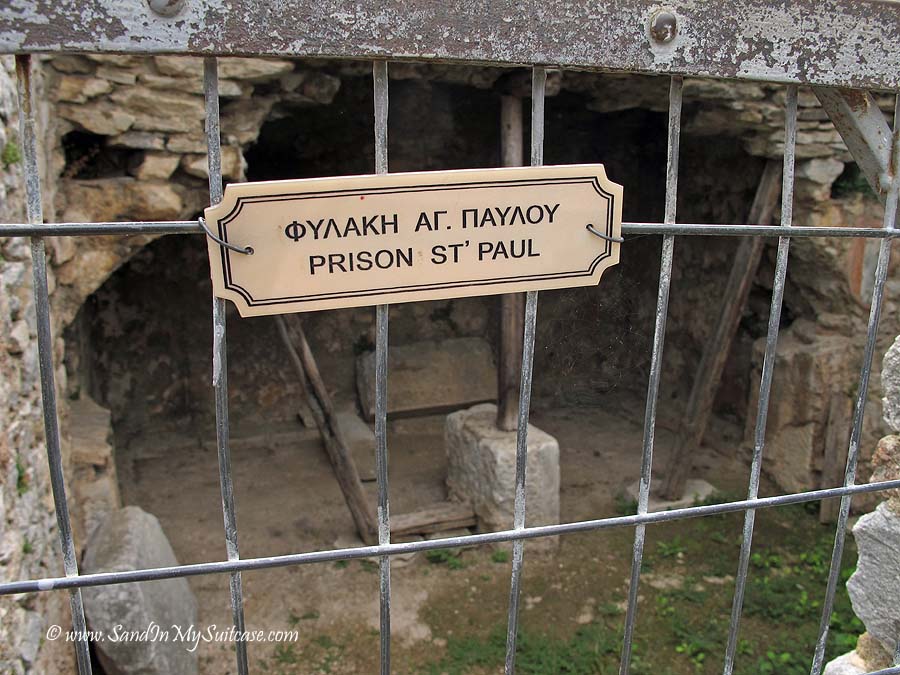
22 The crowd joined in the attack against Paul and Silas, and the magistrates ordered them to be stripped and beaten with rods.23 After they had been severely flogged, they were thrown into prison, and the jailer was commanded to guard them carefully.24 When he received these orders, he put them in the inner cell and fastened their feet in the stocks.
25 About midnight Paul and Silas were praying and singing hymns to God, and the other prisoners were listening to them.26 Suddenly there was such a violent earthquake that the foundations of the prison were shaken. At once all the prison doors flew open, and everyone’s chains came loose.27 The jailer woke up, and when he saw the prison doors open, he drew his sword and was about to kill himself because he thought the prisoners had escaped.28 But Paul shouted, “Don’t harm yourself! We are all here!”
29 The jailer called for lights, rushed in and fell trembling before Paul and Silas.30 He then brought them out and asked, “Sirs, what must I do to be saved?”
31 They replied, “Believe in the Lord Jesus, and you will be saved—you and your household.”32 Then they spoke the word of the Lord to him and to all the others in his house.33 At that hour of the night the jailer took them and washed their wounds; then immediately he and all his household were baptised.34 The jailer brought them into his house and set a meal before them; he was filled with joy because he had come to believe in God—he and his whole household.
35 When it was daylight, the magistrates sent their officers to the jailer with the order: “Release those men.”36 The jailer told Paul, “The magistrates have ordered that you and Silas be released. Now you can leave. Go in peace.”
37 But Paul said to the officers: “They beat us publicly without a trial, even though we are Roman citizens, and threw us into prison. And now do they want to get rid of us quietly? No! Let them come themselves and escort us out.”
38 The officers reported this to the magistrates, and when they heard that Paul and Silas were Roman citizens, they were alarmed.39 They came to appease them and escorted them from the prison, requesting them to leave the city.40 After Paul and Silas came out of the prison, they went to Lydia’s house, where they met with the brothers and sisters and encouraged them. Then they left.
Pip: Faith, health, and the general chaos of being alive — if there's a better brief for a devotional site, I haven't found it.
Mara: Kenneth has been writing on exactly that territory, and today we're looking at a piece that sits right at the heart of it — the image of Christ standing at a closed door, and what it asks of us.
Pip: Let's start with that image, and the hymn behind it.
Light of the World
Mara: This segment is about a single, persistent image — Jesus outside a shut door, waiting. The post asks, quietly, what it means that the door is still closed.
Pip: The hymn at the centre of the post makes the stakes plain. The setup is William How's words, carried through three verses of mounting weight, and the second verse lands hardest: "O Jesus, thou art knocking; and lo, that hand is scarred, and thorns thy brow encircle, and tears thy face have marred: O love that passeth knowledge, so patiently to wait! O sin that hath no equal, so fast to bar the gate!"
Mara: What that verse is doing is connecting the knocking hand to the crucified hand. The patience isn't abstract — it belongs to someone who has already paid a cost. That's what makes the closed door a moral weight, not just a metaphor.
Pip: The post doesn't just stay with the hymn on the page. It opens with a Salvation Army band piece — "The Light of the World," composed by Dean Goffin — and Kenneth notes that if you listen carefully, the bottom end of the band actually emphasises the knocking. The music is performing the theology.
Mara: And then there's Holman Hunt's painting of the same scene — Jesus standing outside a door with no handle on the outside — which Kenneth places at St Paul's Cathedral in London. Text, music, and canvas all working the same image from different angles.
Pip: Kenneth closes by admitting he was moved to tears watching the video he'd chosen to accompany the post. For a piece about a door that's been left shut, that's a fairly direct answer to the question it raises.
Mara: The image of waiting — patient, scarred, unhurried — is the thing that carries across all three forms. The door remains the listener's to open.
Pip: A hymn, a painting, a brass band — three different languages for the same invitation.
Mara: And the door still has no handle on the outside. That's the detail that stays with you.
Pip: There's something quietly radical about a site that holds together colonoscopies and resurrection in the same week — as if the body and the soul both deserve a proper look inside.
Mara: Kenneth covers exactly that this episode — a plain-language guide to what endoscopy actually is and does, and then a reflection on Romans 6 and what it means to be alive in Christ rather than ruled by sin.
Pip: Let's start with what happens when doctors need a closer look.
What Endoscopy Is and Why It Matters
Mara: The post on endoscopy sets out to demystify a procedure that many people find daunting — what it involves, what it examines, and why a doctor might order one.
Pip: Harvard Health is quoted directly in the piece, and the description is worth reading aloud: "An upper endoscopy allows the doctor to explore the cause of such symptoms as difficulty swallowing, abdominal pain, vomiting up blood, or passing blood in the stool."
Mara: So the upshot is that this is a diagnostic tool with real reach — not just the stomach, but the oesophagus, bowel, bladder, lungs, and womb, depending on the type ordered.
Pip: And the types have names most of us have never had reason to learn — gastroscopy, colonoscopy, bronchoscopy, cystoscopy, hysteroscopy — each one a different entry point into a different system.
Mara: Most procedures take between thirty minutes and two hours, and sedation or local anaesthetic means patients typically feel pressure rather than pain.
Pip: A thin tube with a camera turns out to be doing a lot of quiet, essential work.
Mara: That same idea — seeing clearly what's hidden — carries into the next territory, though the instrument is scripture rather than an endoscope.
Dead to Sin, Alive in Christ
Mara: The post titled Jesus Lives centres on Romans 6, which asks a pointed question: if grace covers sin, does that mean sin no longer matters?
Pip: Paul's answer is immediate and unambiguous — the passage reads, "By no means! We are those who have died to sin; how can we live in it any longer?"
Mara: What this means in practice is that baptism, in Paul's framing, is not a ritual of membership but a participation in death and resurrection — the old self crucified, a new life made possible.
Pip: The stakes sharpen further by verse fourteen: "sin shall no longer be your master, because you are not under the law, but under grace." Grace here is not permission — it's transfer of ownership.
Mara: The reflection closes by connecting the passage to a Salvation Army chorus — "It's no longer I that liveth, but Christ that liveth in me" — which distils the whole argument of Romans 6 into a single repeated line.
Pip: Doctrine set to music tends to travel further than doctrine set to commentary.
Mara: The chorus and the chapter land on the same point: that the life now lived is oriented toward God, not toward the patterns the old self followed.
Pip: A week that moves from the interior of the body to the interior of the self — both asking what's actually going on in there.
Mara: And both suggesting that a clear look, however uncomfortable, is where any honest reckoning begins.
Pip: There's something quietly remarkable about a site that holds brass bands and biblical farewell speeches in the same breath — as if the Spirit moves equally well through a trombone and a tearful dockside goodbye.
Mara: Kenneth's recent posts do exactly that — moving from the devotional music of Salvation Army composer Howard Davies to Paul's charged farewell address to the Ephesian elders in Acts 20. Let's start with the music.
Howard Davies and Salvation Army Music
Mara: Howard Davies is an internationally known Salvation Army composer whose work spans songster choirs, brass band arrangements, and devotional recordings across multiple countries and decades.
Pip: The post notes that his brass band selection "Songs of Encouragement" from 1978 incorporates melodies including "Guardian Grace," "His Eye Is on the Sparrow," and "Keep on Believing" — and is still available today through the Salvation Army Music Index.
Mara: What that longevity signals is that his music has remained genuinely useful in worship, not just historically interesting. His book Words and Music adds another layer — it documents the stories and inspiration behind the songs, making him a chronicler of Army musical heritage as much as a composer.
Pip: Devotional music with footnotes. There are worse legacies.
Compelled by the Spirit: Paul's Farewell at Miletus
Mara: Acts 20 presents one of the most personally revealing moments in Paul's ministry — a farewell speech where he accounts for his conduct, warns of what's coming, and explains why he's pressing on anyway.
Pip: The post anchors on verse 22, where Paul says directly: "And now, compelled by the Spirit, I am going to Jerusalem, not knowing what will happen to me there."
Mara: That single line carries the weight of the whole passage. He knows hardship is ahead — the Spirit has told him so in every city — yet the compulsion overrides the calculation. The destination is certain; the outcome is not.
Pip: It's a remarkable posture. Not blind faith, not recklessness — he's fully informed and going anyway.
Mara: Verse 24 sharpens it further: "I consider my life worth nothing to me; my only aim is to finish the race and complete the task the Lord Jesus has given me — the task of testifying to the good news of God's grace."
Pip: That's not resignation. That's a man who has genuinely reordered what counts as a loss.
Mara: The farewell itself is visceral. Paul warns the elders that savage wolves will come after he leaves, urges them to guard the flock, and reminds them he worked with his own hands rather than taking from them. When he finishes, they weep and embrace him — grieved most, the text says, that they will never see his face again.
Pip: A dockside goodbye that still lands two thousand years later.
Mara: From a brass band selection still in print after nearly fifty years to a farewell speech still read across the world — both posts are really about what it means to give your work to something larger than yourself.
Pip: Next time, we'll see what else from this corner of the internet is worth the journey.
3 I heard a loud voice from the throne say, “See, the tent of God is among humans! He will make his home with them, and they will be his people. God himself will be with them, and he will be their God. 4 He will wipe every tear from their eyes. There won’t be death anymore. There won’t be any grief, crying, or pain, because the first things have disappeared.”
I came across this song by The Melbourne Veterans Band a while ago and have always thought what a great testimony. You notice in the first half of verses everything refers to our ‘Earthly World’ and the second half he refers to ‘a Better World’ where men are saved to God and eternity
Unfortunately I have been unable to get the words of the song
12 “I, wisdom, dwell together with prudence; I possess knowledge and discretion. 13 To fear the Lord is to hate evil; I hate pride and arrogance, evil behaviour and perverse speech. 14 Counsel and sound judgment are mine; I have insight, I have power. 15 By me kings reign and rulers issue decrees that are just; 16 by me princes govern, and nobles—all who rule on earth.[b] 17 I love those who love me, and those who seek me find me. 18 With me are riches and honour, enduring wealth and prosperity. 19 My fruit is better than fine gold; what I yield surpasses choice silver. 20 I walk in the way of righteousness, along the paths of justice, 21 bestowing a rich inheritance on those who love me and making their treasuries full.