“The angel of the Lord encamps around those who fear Him, and delivers them.”
This verse is a powerful assurance of divine protection. Here’s a breakdown of its deeper meaning:
🌟 Symbolism and Interpretation
“Angel of the Lord”: Often interpreted as a manifestation of God’s presence—some scholars even see this as a reference to the pre-incarnate Christ.
“Encamps around”: Suggests a constant, surrounding protection—like a military guard or a sheltering presence.
“Those who fear Him”: Not fear in the sense of terror, but reverence, awe, and deep respect for God’s holiness and authority.
“Delivers them”: God actively rescues and intervenes in the lives of those who trust and honor Him.
💬 Spiritual Insight
David wrote this psalm after being delivered from danger, and he uses this verse to highlight how God’s protection isn’t passive—it’s intentional and personal. The image of an angel setting up camp around someone evokes a sense of belonging, safety, and divine watchfulness.
🕊️ Encouragement
This verse reminds believers that they are never alone in their struggles. Whether facing fear, uncertainty, or spiritual battles, God’s presence surrounds and defends those who seek Him with reverence
1 Corinthians 15:12-20 12 But if it is preached that Christ has been raised from the dead, how can some of you say that there is no resurrection of the dead? 13 If there is no resurrection of the dead, then not even Christ has been raised. 14 And if Christ has not been raised, our preaching is useless and so is your faith. 15 More than that, we are then found to be false witnesses about God, for we have testified about God that he raised Christ from the dead. But he did not raise him if in fact the dead are not raised. 16 For if the dead are not raised, then Christ has not been raised either. 17 And if Christ has not been raised, your faith is futile; you are still in your sins. 18 Then those also who have fallen asleep in Christ are lost. 19 If only for this life we have hope in Christ, we are of all people most to be pitied. 20 But Christ has indeed been raised from the dead, the first fruits of those who have fallen asleep.
I love this passage from Corinthians, it gives us a reminder that Christ did die for our sins and that unless you accept him as your personal saviour you will remain a sinner.
1. O joyful sound! O glorious hour
When Christ by His almighty power
Arose and left the grave!
Now let our songs His triumph tell
Who broke the chains of death and hell,
And ever lives to save.
Refrain
He lives, He lives,
I know that my Redeemer lives.
He lives, He lives,
I know that my Redeemer lives.
2. The first begotten of the dead,
For us He rose, our glorious Head,
Immortal life to bring.
What though the saints, like Him shall die,
They share their Leader’s victory,
And triumph with their King. [Refrain]
3. No more we tremble at the grave;
For He who died our souls to save
Will raise our bodies, too.
What though this earthly house shall fail,
The Saviour’s power will yet prevail
And build it up anew. [Refrain]
Pictured in the video are The International Staff Band and The Melbourne Staff Band of The Salvation Army
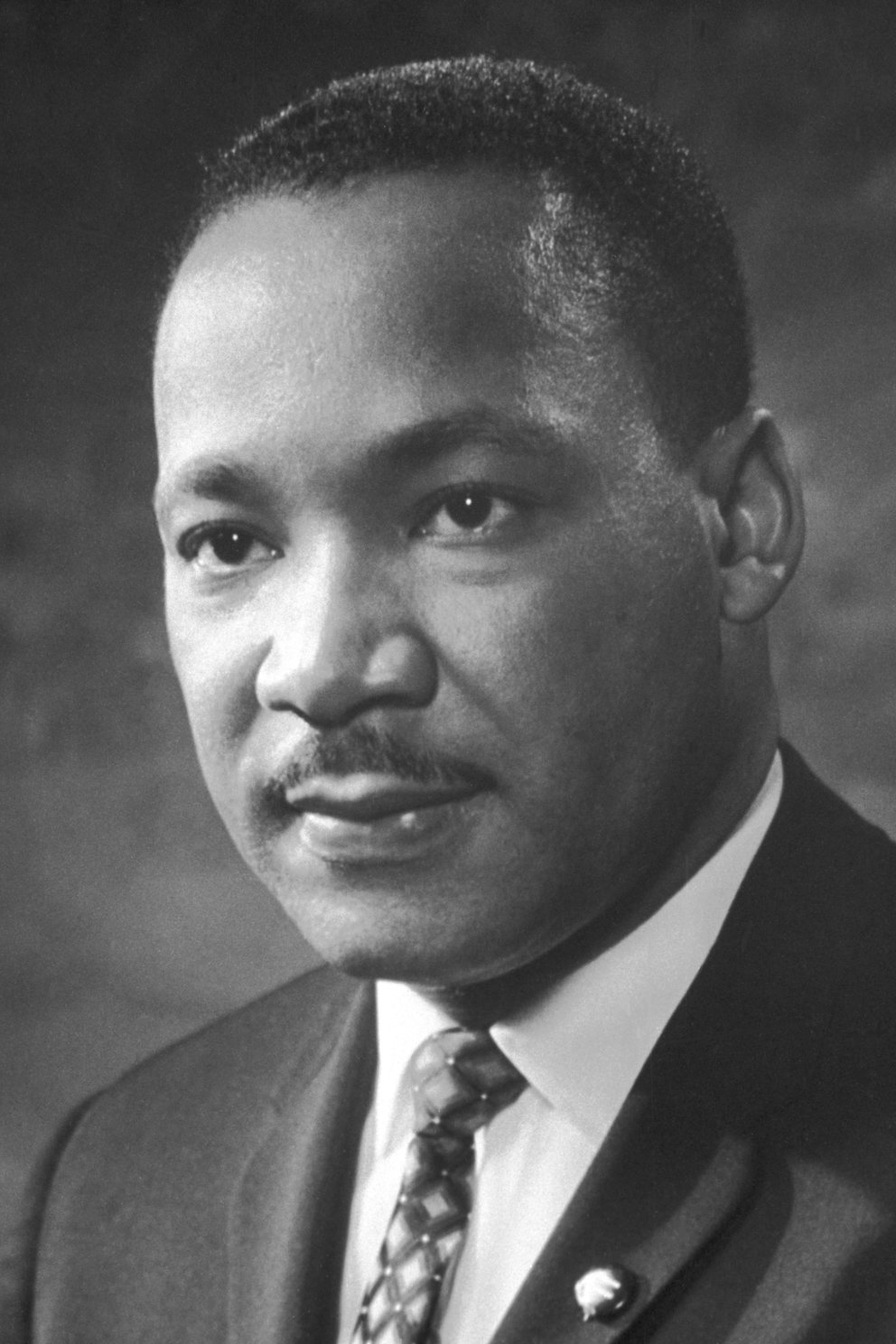
Martin Luther King, Jr., (January 15, 1929-April 4, 1968) was born Michael Luther King, Jr., but later had his name changed to Martin. His grandfather began the family’s long tenure as pastors of the Ebenezer Baptist Church in Atlanta, serving from 1914 to 1931; his father has served from then until the present, and from 1960 until his death Martin Luther acted as co-pastor. Martin Luther attended segregated public schools in Georgia, graduating from high school at the age of fifteen; he received the B. A. degree in 1948 from Morehouse College, a distinguished Negro institution of Atlanta from which both his father and grandfather had graduated. After three years of theological study at Crozer Theological Seminary in Pennsylvania where he was elected president of a predominantly white senior class, he was awarded the B.D. in 1951. With a fellowship won at Crozer, he enrolled in graduate studies at Boston University, completing his residence for the doctorate in 1953 and receiving the degree in 1955. In Boston he met and married Coretta Scott, a young woman of uncommon intellectual and artistic attainments. Two sons and two daughters were born into the family.
In 1954, Martin Luther King became pastor of the Dexter Avenue Baptist Church in Montgomery, Alabama. Always a strong worker for civil rights for members of his race, King was, by this time, a member of the executive committee of the National Association for the Advancement of Colored People, the leading organization of its kind in the nation. He was ready, then, early in December, 1955, to accept the leadership of the first great Negro nonviolent demonstration of contemporary times in the United States, the bus boycott described by Gunnar Jahn in his presentation speech in honor of the laureate. The boycott lasted 382 days. On December 21, 1956, after the Supreme Court of the United States had declared unconstitutional the laws requiring segregation on buses, Negroes and whites rode the buses as equals. During these days of boycott, King was arrested, his home was bombed, he was subjected to personal abuse, but at the same time he emerged as a Negro leader of the first rank.
In 1957 he was elected president of the Southern Christian Leadership Conference, an organization formed to provide new leadership for the now burgeoning civil rights movement. The ideals for this organization he took from Christianity; its operational techniques from Gandhi. In the eleven-year period between 1957 and 1968, King traveled over six million miles and spoke over twenty-five hundred times, appearing wherever there was injustice, protest, and action; and meanwhile he wrote five books as well as numerous articles. In these years, he led a massive protest in Birmingham, Alabama, that caught the attention of the entire world, providing what he called a coalition of conscience. and inspiring his “Letter from a Birmingham Jail”, a manifesto of the Negro revolution; he planned the drives in Alabama for the registration of Negroes as voters; he directed the peaceful march on Washington, D.C., of 250,000 people to whom he delivered his address, “l Have a Dream”, he conferred with President John F. Kennedy and campaigned for President Lyndon B. Johnson; he was arrested upwards of twenty times and assaulted at least four times; he was awarded five honorary degrees; was named Man of the Year by Time magazine in 1963; and became not only the symbolic leader of American blacks but also a world figure.
At the age of thirty-five, Martin Luther King, Jr., was the youngest man to have received the Nobel Peace Prize. When notified of his selection, he announced that he would turn over the prize money of $54,123 to the furtherance of the civil rights movement.
On the evening of April 4, 1968, while standing on the balcony of his motel room in Memphis, Tennessee, where he was to lead a protest march in sympathy with striking garbage workers of that city, he was assassinated.
Steadfast love is a phrase brimming with richness, especially in spiritual and devotional contexts—it evokes the unwavering, covenantal affection attributed to God’s nature throughout scripture.
Here’s how it’s often understood and explored:
🌟 Biblical Meaning
Hebrew roots: The term often translates from the Hebrew word chesed—a deeply layered word encompassing mercy, faithfulness, loyalty, and compassion.
God’s character: Steadfast love in scripture reflects God’s enduring commitment to His people, despite their failures. It’s not just emotional affection; it’s active, sustaining grace.
Key verses:
“The steadfast love of the Lord never ceases; his mercies never come to an end” – Lamentations 3:22
“Your steadfast love, O Lord, extends to the heavens, your faithfulness to the clouds” – Psalm 36:5
And they devoted themselves to the apostles’ teaching and the fellowship, to the breaking of bread and the prayers. And awe came upon every soul, and many wonders and signs were being done through the apostles. And all who believed were together and had all things in common. And they were selling their possessions and belongings and distributing the proceeds to all, as any had need. And day by day, attending the temple together and breaking bread in their homes, they received their food with glad and generous hearts,
To have a good fellowship in your church you not only need unity and kindness amongst other things . If there is a good and positive fellowship in your church it should help it to grow. Should that positive fellowship turn to negative fellowship and the unity in the church ceases to exist then that’s when the devil get’s in a the church will decline.
I have seen this first hand in one church I was a member off and it wasn’t a pleasant thing to witness. Needless to say it wasn’t long before I found another church where I felt at home.
What John 14:27 is promising is that peace isn’t found in the absence of the storms, but in the presence of Jesus. Peace is the inheritance that God gives his children. It’s what he wants you to have. Jesus is saying that his peace is different than what the world offers.
Recently, my wife and I have felt we have been ignored by our church fellowship, which is something we are not happy about
I also have a different issue I need to get off my chest. It is a burden I have been carrying for several weeks now. Although our church is a small one and only has three elders, it hasn’t been easy to get to speak to them
I should state that neither my wife nor myself have lost our faith
We are currently on holiday at the moment trying to relax, but I’m afraid it’s being overshadowed by the above issue.
13A cheerful heart brings a smile to your face; a sad heart makes it hard to get through the day.
14An intelligent person is always eager to take in more truth; fools feed on fast-food fads and fancies.
15A miserable heart means a miserable life; a cheerful heart fills the day with song.
16A simple life in the Fear-of-God is better than a rich life with a ton of headaches.
17Better a bread crust shared in love than a slab of prime rib served in hate.
18Hot tempers start fights; a calm, cool spirit keeps the peace.
19The path of lazy people is overgrown with briers; the diligent walk down a smooth road.
20Intelligent children make their parents proud; lazy students embarrass their parents.
21The empty-headed treat life as a plaything; the perceptive grasp its meaning and make a go of it.
22Refuse good advice and watch your plans fail; take good counsel and watch them succeed.
23Congenial conversation – what a pleasure! The right word at the right time – beautiful!
I don’t suppose I’ll have to tell anyone reading this that it take more facial muscles to frown than to smile. Don’t you think it’s a lot better to feel happy than down right miserable, I do! I believe God would have us being happy than sad. I also believe that because we know Christ as our Saviour we are joyful and it is our duty as Christians to go out into the world and reach out to those who don’t know Christ as their saviour.
13 If I speak in the tongues[a] of men or of angels, but do not have love, I am only a resounding gong or a clanging cymbal. 2 If I have the gift of prophecy and can fathom all mysteries and all knowledge, and if I have a faith that can move mountains, but do not have love, I am nothing. 3 If I give all I possess to the poor and give over my body to hardship that I may boast,[b] but do not have love, I gain nothing.
4 Love is patient, love is kind. It does not envy, it does not boast, it is not proud. 5 It does not dishonour others, it is not self-seeking, it is not easily angered, it keeps no record of wrongs. 6 Love does not delight in evil but rejoices with the truth. 7 It always protects, always trusts, always hopes, always perseveres.
8 Love never fails. But where there are prophecies, they will cease; where there are tongues, they will be stilled; where there is knowledge, it will pass away. 9 For we know in part and we prophesy in part, 10 but when completeness comes, what is in part disappears. 11 When I was a child, I talked like a child, I thought like a child, I reasoned like a child. When I became a man, I put the ways of childhood behind me. 12 For now we see only a reflection as in a mirror; then we shall see face to face. Now I know in part; then I shall know fully, even as I am fully known.
13 And now these three remain: faith, hope and love. But the greatest of these is love.
Not so long ago The Salvation Army released music of the same title of today’s blog to which they put the words of a well known hymn.
When I survey the wondrous cross
On which the Prince of glory died,
My richest gain I count but loss,
And pour contempt on all my pride.
Forbid it, Lord, that I should boast,
Save in the death of Christ my God!
All the vain things that charm me most,
I sacrifice them to His blood.
See from His head, His hands, His feet,
Sorrow and love flow mingled down!
Did e’er such love and sorrow meet,
Or thorns compose so rich a crown?
Were the whole realm of nature mine,
That were a present far too small;
Love so amazing, so divine,
Demands my soul, my life, my all.







 a smooth road.
 Christian Devotions, Health and General issues of the day