Isaiah 25:1-5New International Version – UK (NIVUK)
Praise to the Lord
25 Lord, you are my God; I will exalt you and praise your name, for in perfect faithfulness you have done wonderful things, things planned long ago. 2 You have made the city a heap of rubble, the fortified town a ruin, the foreigners’ stronghold a city no more; it will never be rebuilt. 3 Therefore strong peoples will honour you; cities of ruthless nations will revere you. 4 You have been a refuge for the poor, a refuge for the needy in their distress, a shelter from the storm and a shade from the heat. For the breath of the ruthless is like a storm driving against a wall 5 and like the heat of the desert. You silence the uproar of foreigners; as heat is reduced by the shadow of a cloud, so the song of the ruthless is stilled.
I’ve had many tears and sorrows, I’ve had questions for tomorrow, There’ve been times I didn’t know right from wrong: But in every situation God gave blessed consolation That my trials come To only make me strong.
Through it all, through it all, I’ve learned to trust in Jesus, I’ve learned to trust in God; Through it all, through it all, I’ve learned to depend upon His Word.
I’ve been to lots of places, And I’ve seen a lot of faces, There’ve been times I felt so all alone; But in my lonely hours, Yes, those precious lonely hours, Jesus let me know that I was His own.
Through it all, through it all, I’ve learned to trust in Jesus, I’ve learned to trust in God; Through it all, through it all, I’ve learned to depend upon His Word.
I thank God for the mountains, And I thank Him for the valleys, I thank Him for the storms He brought me through; For if I’d never had a problem I wouldn’t know That He could solve them, I’d never know what faith In God could do.
Through it all, through it all, I’ve learned to trust in Jesus, I’ve learned to trust in God; Through it all, through it all, I’ve learned to depend upon His Word.
When God says no, He has a plan. Keep trusting Him!
2 I say to the Lord, ‘You are my Lord; apart from you I have no good thing.’ 3 I say of the holy people who are in the land, ‘They are the noble ones in whom is all my delight.’ 4 Those who run after other gods will suffer more and more. I will not pour out libations of blood to such gods or take up their names on my lips.
5 Lord, you alone are my portion and my cup; you make my lot secure. 6 The boundary lines have fallen for me in pleasant places; surely I have a delightful inheritance. 7 I will praise the Lord, who counsels me; even at night my heart instructs me. 8 I keep my eyes always on the Lord. With him at my right hand, I shall not be shaken.
9 Therefore my heart is glad and my tongue rejoices; my body also will rest secure, 10 because you will not abandon me to the realm of the dead, nor will you let your faithful[b] one see decay. 11 You make known to me the path of life; you will fill me with joy in your presence, with eternal pleasures at your right hand.
He leadeth me: O blessed thought! O words with heavenly comfort fraught! Whate’er I do, where’er I be, Still ’tis God’s hand that leadeth me.
“He Leadeth Me” by American Joseph Gilmore (1834-1918) was birthed out of a particular struggle in American history. This hymn was composed in 1862 during the Civil War, a time of upheaval and insecurity. The author was preaching at First Baptist Church in Philadelphia soon after his ordination.
Dr. Carlton R. Young, The United Methodist Hymnal editor, cites Gilmore’s recollections on the hymn’s formation: “I set out to give the people an exposition of the 23rd Psalm, which I had given before on three or four occasions, but this time I did not get further than the words ‘He Leadeth Me.’ Psalm 23:2, ‘he leadeth me beside the still waters,’ became the theme of the song” (Young, 1993, 390).
Subsequently, upon the initiative of Glimore’s wife and without the author’s knowledge, the text appeared in the Boston newspaper Watchman and Reflector (Dec. 4, 1862) under the rather unusual and unexplained pseudonym “Contoocook.” The famous gospel song composer William Bradbury (1816-1868) included these words anonymously with his own tune in his collection The Golden Censer (1864). Bradbury is credited with adding the third line to the famous refrain (in bold italics):
He leadeth me! He leadeth me! By his own hand he leadeth me; His faithful follower I would be, For by his hand he leadeth me.
Joseph H. Gilmore, the son of Joseph A. Gilmore, governor of New Hampshire, received his education from Phillips Academy, Andover, Massachusetts, Brown University, Providence, Rhode Island (1858), and Newton Theological Seminary (1861) where he taught Hebrew. An ordained Baptist minister (1862), Gilmore became a professor after serving churches in Philadelphia, New Hampshire, and New York. He was also a professor of English at the University of Rochester from 1868-1911. A prolific writer for newspapers and periodicals, Gilmore also authored three books in his academic field: The Art of Expression (1876) and Outlines of English and American Literature (1905), as well as a book of poetry, He Leadeth Me, and Other Religious Poems (1877).
Working as his father’s private secretary during the Civil War, he also edited the Concord, New Hampshire Daily Monitor. Gilmore provided further information on the historical context of this hymn:
It was the darkest hour of the Civil War. I did not refer to that fact—that is, I don’t think I did—but it may subconsciously have led me to realize that God’s leadership is the one significant fact in human experience, that it makes no difference how we are led, or whither we are led, so long as we are sure God is leading us. http://www.hymntime.com/tch/htm/h/l/e/hleademe.htm
Stanza 2 of the hymn may suggest the ethos of the national crisis. Drawing on Psalm 23:4a; “Yea, though I walk through the valley of the shadow of death, I will fear no evil” (KJV), Gilmore begins: “Sometimes mid scenes of deepest gloom…”
In stanza 3, the poet offers a particular theological interpretation of Psalm 23:4b: ”thy rod and thy staff they comfort me.” In doing so, he reflects on the concept of complete submission to God’s will found in many gospel songs of this era:
Lord I would place my hand in Thine, nor ever murmur nor repine; content, whatever lot I see, since ‘tis my God that leadeth me.
Consider the similarity between this sentiment and the first stanza of “When Peace Like a River” (1873) by Horatio Spafford (1828-1888): “… whatever my lot, thou hast taught me to say, / ‘It is well, it is well with my soul.’”
Or note “Blessed Assurance” (1873) by Fanny Crosby (1820-1915), in which the poet says: “Perfect submission, all is at rest, / I in my Savior am happy and blest…“ (stanza 3).
Psalm 23:6, “Surely goodness and mercy shall follow me all the days of my life: and I will dwell in the house of the LORD forever” (KJV), provides a basis for the final stanza of the hymn, drawing upon the familiar image of the Jordan River cited throughout Scripture, especially as the place of Jesus’ baptism (Matthew 2:13) and a place where Jesus often conducted his ministry (Matthew 4:25; Mark 3:7-8), and ultimately the passageway from this life to the next:
And when my task on earth is done, When by thy grace the victory’s won, E’en death’s cold wave I will not flee, Since God through Jordan leadeth me.
As is the case with so many gospel songs, the rhetorical strength of this hymn lies in the almost incessant repetition of a single thought: “He/God leadeth me.” When the five quotations of this idea in the four stanzas are added to the three references in the refrain, the singer will have sung “He/God leadeth me” a total of seventeen times by the time the hymn is concluded!
Gilmore seems to have had a humble nature as a poet and lacked ambition in promoting his own work. After handing the draft of the poem to his wife who sent it to The Watchman and Reflector under a pseudonym, Gilmore thought no more about it. Gilmore notes, “Three years later I went to Rochester, New York, to preach as a candidate before the Second Baptist Church. Upon entering the chapel, I took up a hymnbook, thinking, ‘I wonder what they sing.’ The book opened up at “’He Leadeth Me,’ and that was the first time I knew that my hymn had found a place among the songs of the church” (Osbeck, 1982, 87).
When the famous musical evangelist Ira D. Sankey (1840-1908), the musician for renowned evangelist Dwight L. Moody (1837-1899), included Bradbury’s version of the hymn in several editions of Sacred Songs and Solos, its fame was assured. The Salvation Army spread its use throughout Britain when they included it in several of their collections.
Though Gilmore wrote other hymns, it is this hurriedly penned text written at age 28 for which he is remembered. The First Baptist Church of Philadelphia was demolished in 1926. Kenneth Osbeck notes, however, that the words to the first stanza of Gilmore’s hymn appear on a bronze tablet on the large office building that replaced the church with the inscription, “in recognition of the beauty and fame of this beloved hymn, and in remembrance of its distinguished author” (Osbeck, 1982, 88).
3 Praise be to the God and Father of our Lord Jesus Christ! In his great mercy he has given us new birth into a living hope through the resurrection of Jesus Christ from the dead, 4 and into an inheritance that can never perish, spoil or fade. This inheritance is kept in heaven for you, 5 who through faith are shielded by God’s power until the coming of the salvation that is ready to be revealed in the last time. 6 In all this you greatly rejoice, though now for a little while you may have had to suffer grief in all kinds of trials. 7 These have come so that the proven genuineness of your faith – of greater worth than gold, which perishes even though refined by fire – may result in praise, glory and honour when Jesus Christ is revealed. 8 Though you have not seen him, you love him; and even though you do not see him now, you believe in him and are filled with an inexpressible and glorious joy, 9 for you are receiving the end result of your faith, the salvation of your souls.
10 Concerning this salvation, the prophets, who spoke of the grace that was to come to you, searched intently and with the greatest care, 11 trying to find out the time and circumstances to which the Spirit of Christ in them was pointing when he predicted the sufferings of the Messiah and the glories that would follow. 12 It was revealed to them that they were not serving themselves but you, when they spoke of the things that have now been told you by those who have preached the gospel to you by the Holy Spirit sent from heaven. Even angels long to look into these things.
As the varied way of life we journey, Come the plains and then the mountainside, Come the days of joy when birds are singing, And the world is fair and sweet and wide; Then a deeper joy comes, overfilling, From the everlasting throne of love, And all other joy is but an echo From the ever-blessèd heights above.
There are shadows on the earthly pathway Where, at times uncertainly, we tread; In perplexity we halt and linger Till our faith again is upward led. For the heights of truth are ever calling, And celestial radiance from afar On our pilgrim way is gently falling For our comfort where the shadows are.
In the days of peace and golden sunshine, In the days of joy, or days of woe, There is confidence in Him who holds us; There is light to guide us here below. And beyond await the heights of rapture, Where all earthly joys, transcended, fade In the glory of the Saviour’s presence, In the Home eternal He has made.
25 At that time Jesus said, ‘I praise you, Father, Lord of heaven and earth, because you have hidden these things from the wise and learned, and revealed them to little children. 26 Yes, Father, for this is what you were pleased to do.
27 ‘All things have been committed to me by my Father. No one knows the Son except the Father, and no one knows the Father except the Son and those to whom the Son chooses to reveal him.
28 ‘Come to me, all you who are weary and burdened, and I will give you rest.29 Take my yoke upon you and learn from me, for I am gentle and humble in heart, and you will find rest for your souls. 30 For my yoke is easy and my burden is light.’
The Salvation Army is talented not just with musical composer’s but also Composer’s of lyrics.
Two such composer’s were Joy Webb (who wrote the words in the video) and Ivor Bosanko ( who wrote the music).
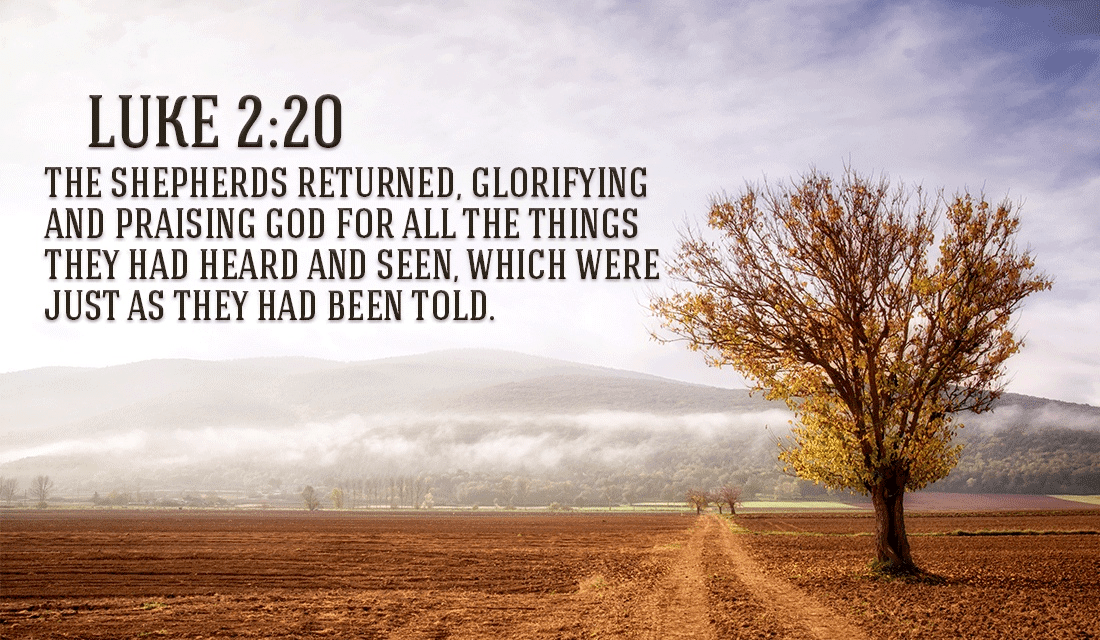
The shepherds’ response of gloryifying and praising God reminds us to give thanks for His guidance in our Christian journey. As Christians we may often focus on the future goals and plans, forgetting to pause and express gratitude for the present moment. Like the sheperds who praised God for the wonderous news of Jesus’ birth, we too should cultivate a heart of gratitude for the oppertunities and blessings God has provided in our lives
Prayer
Heavenly Father, we come before you with hearts full of gratitude for your giudance and blessings in our Christian journey. Help us to cultivate a spirit of thankfulness in our hearts and attitudes. May we be quick to praise and give thanks for the opportunities and successes you have granted us. Let our Christian lives be a testimony of your goodness and grace. Amen.
9 After this I looked, and there before me was a great multitude that no one could count, from every nation, tribe, people and language, standing before the throne and before the Lamb. They were wearing white robes and were holding palm branches in their hands. 10 And they cried out in a loud voice:
“Salvation belongs to our God, who sits on the throne, and to the Lamb.”
11 All the angels were standing around the throne and around the elders and the four living creatures. They fell down on their faces before the throne and worshiped God, 12 saying:
“Amen! Praise and glory and wisdom and thanks and honor and power and strength be to our God for ever and ever. Amen!”
13 Then one of the elders asked me, “These in white robes—who are they, and where did they come from?”
14 I answered, “Sir, you know.”
And he said, “These are they who have come out of the great tribulation; they have washed their robes and made them white in the blood of the Lamb. 15 Therefore,
“they are before the throne of God and serve him day and night in his temple; and he who sits on the throne will shelter them with his presence. 16 ‘Never again will they hunger; never again will they thirst. The sun will not beat down on them,’[a] nor any scorching heat. 17 For the Lamb at the centre of the throne will be their shepherd; ‘he will lead them to springs of living water.’[b] ‘And God will wipe away every tear from their eyes.’[c]”
But Martha was distracted by her many tasks, and she came up and asked, “Lord, don’t You care that my sister has left me to serve alone? So tell her to give me a hand.” The Lord answered her, “Martha, Martha, you are worried and upset about many things, but one thing is necessary. Mary has made the right choice, and it will not be taken away from her.”
This is a wonderful hymn written by Theodore H. Kitching, in the Salvation Army’s War Cry, February 6, 1915. The words were sung at the author’s funeral at Clapton Congress Hall in 1930. It’s one of these hymn where the words just seem to match the tune, with the words being so meaningful (especially the last verse) and the tune being played with devotion what else can I say.
How wonderful it is to walk with God
Along the road that holy men have trod;
How wonderful it is to hear Him say:
Fear not, have faith, ’tis I who lead the way!
How wonderful it is to talk with God
When cares sweep o’er my spirit like a flood;
How wonderful it is to hear His voice,
For when He speaks the desert lands rejoice!
How wonderful it is to praise my God,
Who comforts and protects me with His rod;
How wonderful to praise him every hour,
My heart attuned to sing His wondrous power!
How wonderful it is to fight for God,
And point poor sinners to the precious blood;
How wonderful it is to wield His sword
’Gainst sin, the enemy of Christ, my Lord!
How wonderful ’twill be to live with God
When I have crossed death’s deep and swelling flood;
How wonderful to see Him face to face
When I have fought the fight and won the race!
Psalm 103:13-22New International Version – UK (NIVUK)
13 As a father has compassion on his children, so the Lord has compassion on those who fear him; 14 for he knows how we are formed, he remembers that we are dust. 15 The life of mortals is like grass, they flourish like a flower of the field; 16 the wind blows over it and it is gone, and its place remembers it no more. 17 But from everlasting to everlasting the Lord’s love is with those who fear him, and his righteousness with their children’s children – 18 with those who keep his covenant and remember to obey his precepts.
19 The Lord has established his throne in heaven, and his kingdom rules over all.
20 Praise the Lord, you his angels, you mighty ones who do his bidding, who obey his word. 21 Praise the Lord, all his heavenly hosts, you his servants who do his will. 22 Praise the Lord, all his works everywhere in his dominion.
Praise the Lord, my soul.
Such love, pure as the whitest snow
Such love, weeps for the shame I know
Such love, paying the debt I owe
O Jesus, such love
Such love, stilling my restlessness
Such love, filling my emptiness
Such love, showing me holiness
O Jesus, such love
Such love, springs from eternity
Such love, streaming through history
Such love, fountain of life to me
O Jesus, such love
1 It is good to praise the Lord and make music to your name, O Most High, 2 proclaiming your love in the morning and your faithfulness at night, 3 to the music of the ten-stringed lyre and the melody of the harp.
4 For you make me glad by your deeds, Lord; I sing for joy at what your hands have done. 5 How great are your works, Lord, how profound your thoughts! 6 Senseless people do not know, fools do not understand, 7 that though the wicked spring up like grass and all evildoers flourish, they will be destroyed forever.
The Story Behind How Great Thou Art
Stuart K. Hine was a Bristish Methodist missionary on a mission trip in Ukraine in 2931 when he heard the Russian translation of a German song inspired by Carl Boberg’s poem “O Store Gud” (O Great God). Hine began to translation the song to English and added several verses. The third verse was inspired by the conversion of villagers in Russia who cried out to God loudly as the repented and realized God’s love and mercy – “And when I think that God, His Son not sparing, sent Him to die, I scarce can take it in.”
Stuart Hine and his family left Ukraine as famine and World War Two began, and settled in Somerset, Britain where he continued to serve as a missionary to Polish refugees. The forth verse of “How Great Thou Art” was inspired by displaced Russians who experienced great loss and looked forward to seeing their loved ones again in heaven – “When Christ shall come with shoult of acclamation to take me home, what joy shall fill my heart.”
The final English version of “How Great Thou Art” was published in 1949 and quickly spread among Britian, Africa, India and America.
O Lord my God, When I in awesome wonder, Consider all the worlds Thy Hands have made; I see the stars, I hear the rolling thunder, Thy power throughout the universe displayed.
Chorus: Then sings my soul, My Saviour God, to Thee, How great Thou art, How great Thou art. Then sings my soul, My Saviour God, to Thee, How great Thou art, How great Thou art!
When through the woods, and forest glades I wander, And hear the birds sing sweetly in the trees. When I look down, from lofty mountain grandeur And see the brook, and feel the gentle breeze.
And when I think, that God, His Son not sparing; Sent Him to die, I scarce can take it in; That on a Cross, my burdens gladly bearing, He bled and died to take away my sin.
When Christ shall come, with shout of acclamation, And take me home, what joy shall fill my heart. Then I shall bow, in humble adoration, And then proclaim: “My God, how great Thou art!”







 Christian Devotions, Health and General issues of the day