The Bible makes no mention of Easter or Easter Monday. There is no requirement as a church to celebrate it, but there is prohibition either.
Easter Monday as we know is the day after Christ’s resurrection where he said for 40 days appearing to believers and giving ministry. He also healed the sick and proved to doubter’s he was the son of God.
Easter Monday, also called Bright Monday or Renewal Monday, is the beginning of Bright Week. It is common to douse people in water, representing the new life of baptism, and play games with Easter eggs. Such as Easter egg hunt or rolling your a hard boiled egg down a hill (which represents the stone being rolled away).
26 As the soldiers led him away, they seized Simon from Cyrene, who was on his way in from the country, and put the cross on him and made him carry it behind Jesus. 27 A large number of people followed him, including women who mourned and wailed for him. 28 Jesus turned and said to them, “Daughters of Jerusalem, do not weep for me; weep for yourselves and for your children. 29 For the time will come when you will say, ‘Blessed are the childless women, the wombs that never bore and the breasts that never nursed!’ 30 Then
“‘they will say to the mountains, “Fall on us!” and to the hills, “Cover us!”’[b]
31 For if people do these things when the tree is green, what will happen when it is dry?”
32 Two other men, both criminals, were also led out with him to be executed.33 When they came to the place called the Skull, they crucified him there, along with the criminals—one on his right, the other on his left. 34 Jesus said, “Father, forgive them, for they do not know what they are doing.”[c] And they divided up his clothes by casting lots.
35 The people stood watching, and the rulers even sneered at him. They said, “He saved others; let him save himself if he is God’s Messiah, the Chosen One.”
36 The soldiers also came up and mocked him. They offered him wine vinegar 37 and said, “If you are the king of the Jews, save yourself.”
38 There was a written notice above him, which read: this is the king of the jews.
39 One of the criminals who hung there hurled insults at him: “Aren’t you the Messiah? Save yourself and us!”
40 But the other criminal rebuked him. “Don’t you fear God,” he said, “since you are under the same sentence? 41 We are punished justly, for we are getting what our deeds deserve. But this man has done nothing wrong.”
42 Then he said, “Jesus, remember me when you come into your kingdom.[d]”
43 Jesus answered him, “Truly I tell you, today you will be with me in paradise.”
3 We know that we have come to know him if we keep his commands. 4 Whoever says, “I know him,” but does not do what he commands is a liar, and the truth is not in that person. 5 But if anyone obeys his word, love for God[a] is truly made complete in them. This is how we know we are in him: 6 Whoever claims to live in him must live as Jesus did.
7 Dear friends, I am not writing you a new command but an old one, which you have had since the beginning. This old command is the message you have heard. 8 Yet I am writing you a new command; its truth is seen in him and in you, because the darkness is passing and the true light is already shining.
9 Anyone who claims to be in the light but hates a brother or sister[b] is still in the darkness.10 Anyone who loves their brother and sister[c] lives in the light, and there is nothing in them to make them stumble. 11 But anyone who hates a brother or sister is in the darkness and walks around in the darkness. They do not know where they are going, because the darkness has blinded them.
Wow! what a theme to follow yesterdays blog on Reconciliation, comes right to the point doesn’t it
As the above reading is telling us, ‘As Christians we are supposed to love one another’, turn the other cheek etc.
As humans it is only natural that personalities will clash even if you are Christians in the same church.
Even I have fell out with people in my Church but I don’t like the atmosphere it creates and usually when things have calmed down that is usually when the apologies come
A little on that’s full of innocence He doesn’t know that something’s out of place Another one dreams murder all night He’s been living full of hatred all his life Well, I guess it’s always been this way A world that’s full of love and hate Oh God, but will it stay this way So much love, so much hate
It goes on and on and on Around and again On and on and on Around and again It goes on and on and on Around and again
A mother’s willing to give her life While another one throws away her child A son stands and he turns the other cheek While another one spits in a face while it bleeds Well, I guess it’s always been this way A world that’s full of love and hate Oh God, but will it stay this way So much love, so much hate
It goes on and on and on Around and again On and on and on Around and again It goes on and on and on Around and again
It goes on and on and on Around and again On and on and on Around and again It goes on and on and on Around and again
This evil that’s within is hiding in our skin This evil that’s within is hiding in our skin What are we When will we Why are we still wondering What are we When will we Why are we still wondering Oh Jesus, I can’t take the hate anymore Save us from ourselves before We on and on and on Around and again
It goes on and on and on Around and again On and on and on Around and again It goes on and on and on Around and again
On and on and on Around and again It goes on and on and on Around and again
It goes on and on and on Around and again On and on and on Around and again It goes on and on and on Around and again
John Burton, the author, spent much of his life working with young people and writing for them. He was born in Stratford, England, in 1803 and worked as a basketmaker and cooper (barrel maker) for about fifty years. He was a church deacon and a Sunday School teacher. He had hymns published in several collections: The Evangelical Magazine,The Child’s Companion and other periodicals, as well as The Union Hymn Book for Scholars . His own publications were One Hundred Original Hymns for the Young, Hymns for Little Children, and The Book of Psalms in English Verse . Burton died in his home town of Stratford in 1877. He should not be confused with a slightly older John Burton, from Nottingham, England, who also taught Sunday School and wrote children’s hymns. Another person, C.W. Burton, wrote words very similar to these, but no biographical information is available. Perhaps they are the same person!
WORDS: JOHN BURTON, JR.; MUSIC: (TUNE – SOUTH SHIELDS) GEORGE MARSHALL
Saviour, while my heart is tender, I would yield that heart to Thee; All my powers to Thee surrender, Thine and only Thine to be. Take me now, Lord Jesus, take me; Let my youthful heart be Thine; Thy devoted servant make me; Fill my soul with love divine.
Send me, Lord, where Thou wilt send me, Only do Thou guide my way; May Thy grace through life attend me – Gladly then shall I obey. Let me do Thy will or bear it, I would know no will but Thine; Shouldst Thou take my life or spare it, I that life to Thee resign.
May this solemn consecration Never once forgotten be; Let it know no alteration, Registered, confirmed by Thee. Thine I am, O Lord, forever, To Thy service set apart; Suffer me to leave Thee never, Seal Thine image on my heart.
Did you make this commitment and consecration of your life to the Lord as a young person? What would your evaluation be now? If you are a young person reading this, may you indeed find the joy that such a commitment can bring. If you are older, you can still surrender to the purposes God has for you and perhaps find new meaning in the coming days.
2 In those days Caesar Augustus issued a decree that a census should be taken of the entire Roman world. 2 (This was the first census that took place while[a] Quirinius was governor of Syria.) 3 And everyone went to their own town to register.
4 So Joseph also went up from the town of Nazareth in Galilee to Judea, to Bethlehem the town of David, because he belonged to the house and line of David. 5 He went there to register with Mary, who was pledged to be married to him and was expecting a child. 6 While they were there, the time came for the baby to be born, 7 and she gave birth to her firstborn, a son. She wrapped him in cloths and placed him in a manger, because there was no guest room available for them.
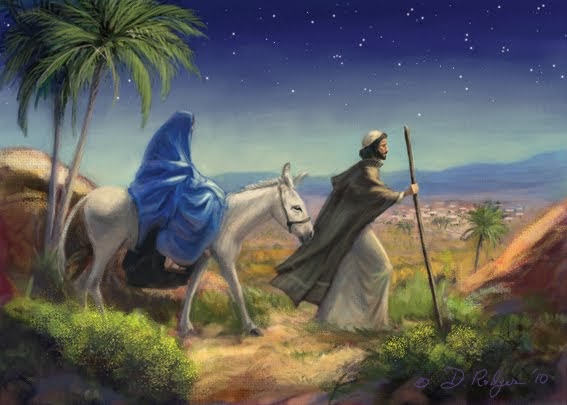
Can you imagine the distance Mary & Joseph had to travel from Nazareth to Bethlehem (about 90 odd miles) on mostly hot days with only a donkey as a way of transport, no cars, buses, trains or planes to get there. What we must remember is it is with God’s guidance they both arrived in Bethlehem safely
How far is it to Bethlehem? Not very far. Shall we find the stable room Lit by a star? Can we see the little Child? Is He within? If we lift the wooden latch May we go in? May we stroke the creatures there Ox, ass, or sheep? May we peep like them and see Jesus asleep? If we touch His tiny hand Will He awake? Will He know we’ve come so far Just for His sake? Great kings have precious gifts And we have naught Little smiles and little tears Are all we brought. For all weary children Mary must weep Here, on His bed of straw Sleep, children, sleep. God in His mother’s arms Babes in the byre Sleep, as they sleep who find Their heart’s desire.
Matthew 13:53-58New International Version – UK (NIVUK)
A prophet without honour
53 When Jesus had finished these parables, he moved on from there. 54 Coming to his home town, he began teaching the people in their synagogue, and they were amazed. ‘Where did this man get this wisdom and these miraculous powers?’ they asked. 55 ‘Isn’t this the carpenter’s son? Isn’t his mother’s name Mary, and aren’t his brothers James, Joseph, Simon and Judas? 56 Aren’t all his sisters with us? Where then did this man get all these things?’ 57 And they took offence at him.
But Jesus said to them, ‘A prophet is not without honour except in his own town and in his own home.’
58 And he did not do many miracles there because of their lack of faith.
Come, Thou long expected Jesus
Born to set Thy people free;
From our fears and sins release us,
Let us find our rest in Thee.
Israel’s strength and consolation,
Hope of all the earth Thou art;
Dear desire of every nation,
Joy of every longing heart.
Born Thy people to deliver,
Born a child and yet a King,
Born to reign in us forever,
Now Thy gracious kingdom bring.
By Thine own eternal Spirit
Rule in all our hearts alone;
By Thine all sufficient merit,
Raise us to Thy glorious throne.
11 “I am the good shepherd. The good shepherd lays down his life for the sheep. 12 The hired hand is not the shepherd and does not own the sheep. So when he sees the wolf coming, he abandons the sheep and runs away. Then the wolf attacks the flock and scatters it. 13 The man runs away because he is a hired hand and cares nothing for the sheep.
14 “I am the good shepherd; I know my sheep and my sheep know me— 15 just as the Father knows me and I know the Father—and I lay down my life for the sheep. 16 I have other sheep that are not of this sheep pen. I must bring them also. They too will listen to my voice, and there shall be one flock and one shepherd. 17 The reason my Father loves me is that I lay down my life—only to take it up again. 18 No one takes it from me, but I lay it down of my own accord. I have authority to lay it down and authority to take it up again. This command I received from my Father.”
In the story of the Good Shepherd we are reminded how Jesus looks after and cares for his flock. As human beings we would do well to remember that even in our darkest moments Jesus is still there looking over us and guiding us
“Blest Are the Pure in Heart” is a hymn based on the Beatitude from Matthew 5:8, which states, “Blessed are the pure in heart, for they shall see God.” This hymn emphasizes the importance of purity of heart in the Christian faith, suggesting that those who maintain a pure heart will be able to see and experience God more fully.
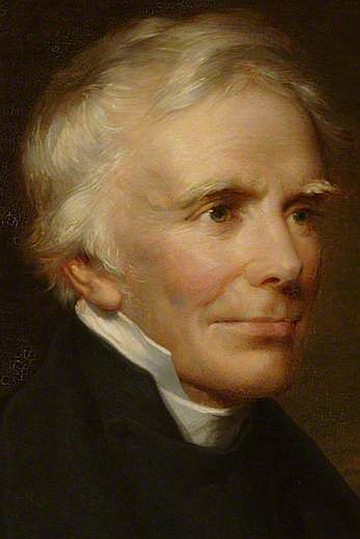
The hymn was written by John Keble, an English churchman and one of the leaders of the Oxford Movement, which sought to revive the Catholic aspects of the Anglican Church in the 19th century. Keble’s hymn reflects his deep theological insights and his desire to inspire a sincere and devout Christian life.
lessed assurance, Jesus is mine! O what a foretaste of glory divine! Heir of salvation, purchase of God, Born of his spirit, washed in his blood. This is my story, this is my song, Praising my Savior all the day long.
Tune composer Phoebe Palmer Knapp (1839-1908) played a melody to Fanny Crosby and asked, “What does the melody say to you?” Crosby replied that the tune said, “Blessed assurance, Jesus is mine!” and proceeded to recite the entire first stanza of the now-famous hymn. Knapp was one of several tune writers that worked with Fanny Crosby. It was not unusual for one of her texts to be inspired by a preexisting tune. Knapp was the composer of more than five hundred gospel hymns and tunes.
Fanny Crosby (1820-1915), blind at the age of six weeks, was a lifelong Methodist who began composing hymns at age six. She became a student at the New York Institute of the Blind at age 15 and joined the faculty of the Institute at 22, teaching rhetoric and history. In 1885, Crosby married Alexander Van Alstyne, also a student at the Institute and later a member of the faculty. He was a fine musician and, like Fanny, a lover of literature.
An author of more than 8,000 gospel hymn texts, she drew her inspiration from her own faith. Crosby published hymns under several pen names including “Ella Dale,” “Mrs. Kate Gringley,” and “Miss Viola V. A.” Her hymn texts were staples for the music of the most prominent gospel song writers of her day.
Frances Jane Crosby’s hymns have historically been among the most popular songs sung by Methodists. “Blessed Assurance” (1873) is one of the ten most popular hymns sung by United Methodists according to Carlton Young, and it is one of eight Crosby hymns in The United Methodist Hymnal.
“Blessed Assurance” was published in 1873 in the monthly magazine edited by Joseph Fairchild Knapp and Phoebe Palmer Knapp, Guide to Holiness. Editor John R. Sweney included it in Gems of Praise (Philadelphia, 1873), and Knapp also chose it for “Bible School Songs” (1873). Perhaps the biggest boost came when it appeared in Gospel Songs, No. 5 (1887) by Ira Sankey and was sung extensively in the Moody and Sankey revivals in Great Britain and the United States. It has been a part of Methodist hymnals since 1889.
This hymn has inspired many singers ranging from those in evangelistic crusades to theologians. Don E. Saliers, William R. Cannon Distinguished Professor of Theology and Worship Emeritus at Candler School of Theology, Emory University in Atlanta, borrowed a portion of the opening stanza for his liturgical theology text, Worship as Theology: Foretaste of Glory Divine (1994). If one enters “foretaste of glory divine” into a Google search, numerous sermon titles appear that incorporate this phrase. YouTube renditions of the hymn abound.
Crosby captured the poetic essence of the Wesleyan understanding of Christian perfection in the phrase, “O what a foretaste of glory divine!” The entire hymn is focused on heaven, a place where “perfect submission” and “perfect delight” [stanza 2] will take place. The earthly existence is one of “watching and waiting, looking above” [stanza 3]. As we submit ourselves to Christ and are “filled with his goodness” and “lost in his love” [stanza 3], we are remade in Christ’s image and are moving toward Christian perfection.
This hymn appeals to the senses in a rich way. Not only do we have a “foretaste of glory,” we experience “visions of rapture [that] burst on my sight,” and we hear “echoes of mercy, whispers of love” [stanza 2].
The refrain calls us to “prais[e]. . . my Savior all the day long,” echoing I Thessalonians 5:17, “Pray without ceasing.”
Because of her long life, Fanny Crosby had an extraordinary relationship with several United States presidents, even penning poems in their honor on occasion, and she was influential on the spiritual life of or a friend to Presidents Martin Van Buren (8th), John Tyler (10th), James K. Polk (11th), and Grover Cleveland (22nd and 24th). She addressed a joint session of Congress on the topic of education for the blind.
Middle class women in nineteenth-century United States had little voice in worship, however. One of the only ways for a woman to claim the authority to be heard was by direct personal revelation from God. Fanny Crosby readily claimed God’s personal revelation as a source for her hymns; her personal revelation then became a communal inspiration as Christians throughout the world sang her hymns and confirmed her faith experience as their own.
6 We do, however, speak a message of wisdom among the mature, but not the wisdom of this age or of the rulers of this age, who are coming to nothing.7 No, we declare God’s wisdom, a mystery that has been hidden and that God destined for our glory before time began.8 None of the rulers of this age understood it, for if they had, they would not have crucified the Lord of glory.9 However, as it is written:
“What no eye has seen, what no ear has heard, and what no human mind has conceived”[b]— the things God has prepared for those who love him—
10 these are the things God has revealed to us by his Spirit.
The Spirit searches all things, even the deep things of God.11 For who knows a person’s thoughts except their own spirit within them? In the same way no one knows the thoughts of God except the Spirit of God.12 What we have received is not the spirit of the world, but the Spirit who is from God, so that we may understand what God has freely given us.13 This is what we speak, not in words taught us by human wisdom but in words taught by the Spirit, explaining spiritual realities with Spirit-taught words.[c]14 The person without the Spirit does not accept the things that come from the Spirit of God but considers them foolishness,and cannot understand them because they are discerned only through the Spirit.15 The person with the Spirit makes judgements about all things, but such a person is not subject to merely human judgements,16 for,
“Who has known the mind of the Lord so as to instruct him?”[d]
But we have the mind of Christ.
There’s a peace I’ve come to know
Though my heart and flesh may fail
There’s an anchor for my soul
I can say “It is well”
Jesus has overcome
And the grave is overwhelmed
The victory is won
He is risen from the dead
And I will rise when He calls my name
No more sorrow, no more pain
I will rise on eagles’ wings
Before my God fall on my knees
And rise
I will rise
There’s a day that’s drawing near
When this darkness breaks to light
And the shadows disappear
And my faith shall be my eyes
Jesus has overcome
And the grave is overwhelmed
The victory is won
He is risen from the dead
And I will rise when He calls my name
No more sorrow, no more pain
I will rise on eagles’ wings
Before my God fall on my knees
And rise
I will rise
And I hear the voice of many angels sing,
“Worthy is the Lamb”
And I hear the cry of every longing heart,
“Worthy is the Lamb”
And I will rise when He calls my name
No more sorrow, no more pain
I will rise on eagles’ wings
Before my God fall on my knees
And rise
I will rise








 Christian Devotions, Health and General issues of the day