Tag: Love

Biography of William Holman Hunt

Childhood, Early Education and Training

The child of humble working-class parents (his father earned his living as a Cheapside warehouse manager) William Holman Hunt (he changed his name from Hobman Hunt on the discovery of the fact that a clerk had misspelled his name on his baptism certificate) was raised as a devout Christian, dedicating his early childhood to reading the Bible in its finest detail. This being Victorian England, Hunt began his working life aged just 12 as an office clerk. It would take a further five years before his parents agreed, albeit reluctantly, to his enrolment at the Royal Academy art school (in 1844). Once there, Hunt made the acquaintance of John Everett Millais and, a little later on, the painter and poet Dante Gabriel Rossetti.
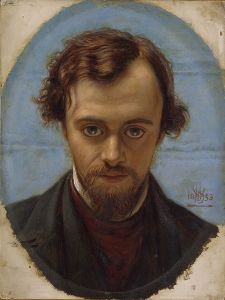
Hunt's portrait of a youthful Dante Gabriel Rossetti, executed in 1853.

Hunt had already made his mark having exhibited at Royal Manchester Institution in 1845, and at the Royal Academy and the British Institution a year later, before the three men formed the Pre-Raphaelite Brotherhood – at Millais’s modest townhouse on Gower Street in Bloomsbury, London – in 1848. The men had grown disenchanted by their experience at the Royal Academy, having taken collective issue with the seemingly entrenched codes of artistic convention; not least the current orthodoxy of working from dark to light. The Brotherhood aspired to a brighter, more dynamic style of painting, driven primarily by close attention to picture detail. Together, they rejected the scholarly conventions of painting in favor of an acutely observation-driven style of representation. Rossetti summarized the aims of the Brotherhood as follows: “1. To have genuine ideas to express; 2. to study Nature attentively, so as to know how to express them; 3. to sympathise with what is direct and serious and heartfelt in previous art, to the exclusion of what is conventional and self-parading and learned by rote; 4. and most indispensable of all, to produce thoroughly good pictures and statues”.

A key stimulus on the Brotherhood project was the critical writing of John Ruskin. Ruskin, author of the book(s) Modern Painters (1843), was a renowned polemicist, moralist, and artist who had, most famously perhaps, championed the seven (tone, color, space, skies, earth, water and vegetation) “truths of natural form” in the expressive landscape paintings of J.M.W. Turner. (Much later, in 1880, Hunt, who was by now well known, wrote to John Ruskin praising him for the influence he had exercised over Hunt’s own art. He explained to Ruskin how he had come to be possessed, not by Turner, but by the poetry of John Keats, and how he (Hunt), under Ruskin’s influence, had come to regard Keats at a benchmark for the material reality he sought in his painting.) Hunt duly invested in the painterly ideal of a spiritual truth that would resound in material objects. It was from Ruskin indeed that Hunt derived the principle that it was not only good to depict things truthfully, it was also morally right. Thus, whereas previously Hunt had pursued a detailed, materially descriptive style, now he comprehended the way that material reality was the stuff of divine creation, and therefore indivisible from a sacred reality.

The Brotherhood lasted only about five years. Of the three founders it was Hunt who remained most committed to the ideals of the Brotherhood (Millais took over the presidency of the Royal Academy while the “amoral” Rossetti used his art to explore the beauty of the female form). In 1950 Hunt sold A Converted British Family Sheltering a Christian Missionary from the Persecution of the Druids to one Thomas Combe. Combe became Hunt’s close friend and business adviser and two years later he sold Hunt’s The Hireling Shepherd to the City of Manchester Art Galleries. Shepherds was significant because it was Hunt’s first work to display his style of divine realism. Meanwhile, Hunt and Millais vacationed at a farm in Surrey in 1853 and it was here that the former produced his first masterpiece: The Light of the World.

Mature Period
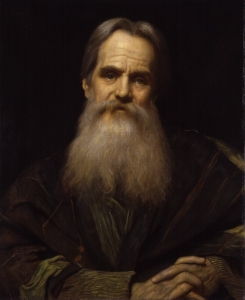
Portrait of Hunt by Sir William Blake Richmond (1900)

A year later the artist left England for Egypt and the Holy Land. To mark his departure, Millais gifted his friend a signet ring. The ring, which Hunt wore for the rest of his life, would become an emblem of the men’s life-long friendship. Hunt’s expedition lasted two years during which time he visited the Great Sphinx of Giza and the Pyramids though he remarked later that “[t]heir only association that I value is that Joseph, Moses and Jesus must have looked upon them.” For his painting The Scapegoat (1854–56), one of his signature pieces, Hunt travelled sixty miles outside Jerusalem where he found a suitably arid, desolate place for the setting of his painting. As he described it in his memoirs (published in 1905 and 1906) his own journey seemed to parallel that of the scapegoat in the picture, with Hunt the artist emerging as the hero of his own narrative. Indeed, Hunt returned to England in February 1856 sporting a voluminous beard. He saw the beard (as illustrated in William Blake Richmond’s 1877 and 1900 portraits of the artist) as somehow prophetic and he was to present himself henceforward as an untamed artistic genius.
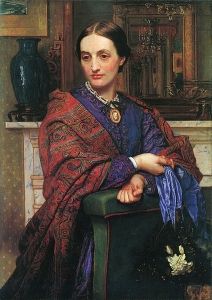
Hunt's portrait of his first wife Fanny Hunt née Waugh (1866-68)

In 1865 Hunt married Fanny Waugh. The couple soon embarked on a tour of the Middle East in 1866 and it was while in quarantine in Florence that Fanny gave birth to a son. Their joy was short-lived however as Fanny lost her life to miliary fever. In 1868, Hunt returned to Florence to work on a memorial to Fanny (which beautifies the city’s Protestant Cemetery to this day). Hunt journeyed to the Holy Land again in August 1869. This time his stay lasted five years, during which time he worked tirelessly on the detail for his painting The Shadow of Death. Hunt worked on the background to the picture while in Nazareth (“whence he could command a charming panorama of cultivated landscape and distant hills”, according to his biographer A.C. Gissing). Indeed, the Holy Land exercised a huge pull on Hunt’s romantic vision of the past, though by physically inhabiting the places he sought to represent through his art, Hunt was able to achieve the material accuracy he sought in his updated renderings of Biblical narratives.

Late Period

Hunt’s self-styled piety was to be demeaned when he married Fanny’s sister, Edith, in 1875. According to English law, it was illegal to marry the sister of one’s deceased wife (the ceremony was conducted overseas) the legal consensus being that the new marriage constituted a form of incest. The couple duly took leave in Jerusalem where Hunt began work on The Triumph of the Innocents (1870–1903). At home meanwhile the scandal had caused considerable disquiet, especially within the Waugh clan, who considered it a stain on the family’s proud history. Some fifty years on – perhaps as an act of familial ‘revenge’ – Evelyn Waugh, the novelist and great nephew of the Waugh sisters, published a monograph, not about Hunt, but rather on the artist’s erstwhile colleague Rossetti.
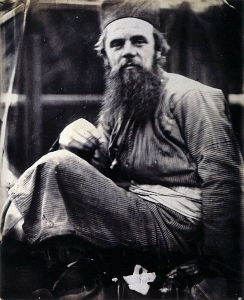
Julia Margaret Cameron's photograph of Hunt in eastern costume, taken in 1864.

Though Hunt had exhibited regularly at the Royal Academy between the 1840s and 1860s, he made a definitive break with the organization in the 1870s. His final involvement with the Academy was in 1874, when he exhibited a portrait of his patron Thomas Fairbairn. Intriguingly, in the exhibition catalogue for that year he gave a split address, suggesting dual residence between 10 The Terrace, Hammersmith, and Jerusalem. He was living in Jerusalem in fact when the 1874 exhibition took place. Thereafter, Hunt preferred to exhibit at the Grosvenor Gallery and the New Gallery, both of which were aligned with an eclectic milieu of painters that ranged from other Pre-Raphaelites to (what Hunt saw as vain and ‘foppish’) aesthetes like J.A.M. Whistler.

Despite his advancing years, Hunt remained actively involved with art world politics during the 1880s. For instance, in 1886, with George Clausen and Walter Crane, he signed a letter lambasting the Royal Academy for its restrictive exhibition practices, while in the same year, with Ford Madox Brown, he established the Arts and Crafts Exhibiting Society. Though not directly affiliated with the Arts and Crafts Movement, the Society’s intention was to facilitate the exhibition of “fine art” alongside a so-called “decorative art”, including furniture and designs for stained glass windows. Hunt himself had paid special attention to the framing of his works throughout his career, treating his frames as iconographical extensions of the pictures that they contained.

Hunt’s first career retrospective was held in London in 1886 and was complemented with a collection of articles on the Pre-Raphaelite Brotherhood in the Contemporary Review. Though future artistic undertakings were curtailed due to deteriorating eyesight and a serious asthma condition, Hunt visited the Middle East one last time in 1892. In 1905 he was awarded the Order of Merit and an honorary Doctorate of Civil Law by Oxford University. Following the publication of his memoirs in 1905-06, In 1907 his painting The Ship was purchased by a group of benefactors who presented the work to the Tate Gallery as a mark of respect, and to commemorate the artist’s eightieth birthday. Hunt died in London in 1910.

The Legacy of William Holman Hunt

In a fate that befell other Pre-Raphaelite painters, Hunt’s work fell from grace in the later decades of the nineteenth century. Though Hunt continued to work through this period, he had been long-since overtaken in the popular imagination by more youthful, frivolous, and less earnest forms of art. However, the dandyish aestheticism of J.A.M. Whistler – an artist who did so much to dent Hunt’s reputation – was largely a response to the Pre-Raphaelites. Hunt, and the Ruskinian milieu in which he worked, were in fact central to later developments in art, not least because artists like Whistler, if they were to make a name for themselves at all, had to reject what had gone before. As is so often the case with art, however, the division between Hunt and Whistler’s paintings was not so clear cut and in fact they merely define one another. Indeed, the two artists exhibited alongside each other on a number of occasions.

It was not until the early decades of the twentieth century however that Hunt started to excite the imagination of the new generation of painters. A retrospective held in 1906 and 1907, touring from London to Manchester, Liverpool and Glasgow, marked a revival of interest in his work. Certain works by painters like Harold Speed, such as in his 1905 portrait of the Arts and Crafts pioneer C.F.A. Voysey, suggest a debt of influence to Hunt. Other artists at this time, like Charles Ricketts and Charles Haslewood Shannon, (though their own preference was for Venetian painting and Tintoretto) seem to have absorbed Hunt’s approach to history too, specifically through their debt to a hallowed pre-Raphaelite style. Though Hunt had various defenders in the twentieth century (including, conversely, Evelyn Waugh who owned works by him) Hunt’s reputation would often languish due not least to the sweeping onset of modernism (in 1978, the Oxford Companion to Art stated in fact that “[m]ost of his works are now regarded as failures”). More recently, however, the ebb and flow of artistic taste has allowed for a critical revision of nineteenth-century British painting and in that context, Hunt emerges as one of its most revered sons.

Holmun Hunt also painted a picture of Jesus sanding outside a door knocking and I believe this can be seen in St Paul’s Cathedral, London.
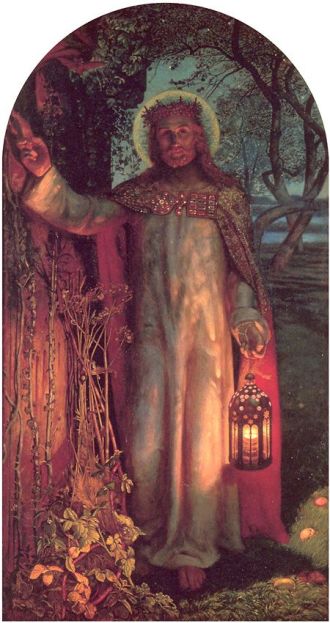
Image result for jesus knocking at the door painting

O Jesus, thou art standing,
outside the fast closed door,
in lowly patience waiting
to pass the threshold o’er:
shame on us, Christian brothers,
his Name and sign who bear,
O shame, thrice shame upon us,
to keep him standing there!

O Jesus, thou art knocking;
and lo, that hand is scarred,
and thorns thy brow encircle,
and tears thy face have marred:
O love that passeth knowledge,
so patiently to wait!
O sin that hath no equal,
so fast to bar the gate!

O Jesus, thou art pleading
in accents meek and low,
“I died for you, my children,
and will you treat me so?”
O Lord, with shame and sorrow
we open now the door;
dear Savior, enter, enter,
and leave us never more.
A Story of Love

Luke 2 New International Version

The Birth of Jesus

In those days Caesar Augustus issued a decree that a census should be taken of the entire Roman world. (This was the first census that took place while[a] Quirinius was governor of Syria.) And everyone went to their own town to register.

So Joseph also went up from the town of Nazareth in Galilee to Judea, to Bethlehem the town of David, because he belonged to the house and line of David. He went there to register with Mary, who was pledged to be married to him and was expecting a child. While they were there, the time came for the baby to be born, and she gave birth to her firstborn, a son. She wrapped him in cloths and placed him in a manger, because there was no guest room available for them.

And there were shepherds living out in the fields nearby, keeping watch over their flocks at night. An angel of the Lord appeared to them, and the glory of the Lord shone around them, and they were terrified. 10 But the angel said to them, “Do not be afraid. I bring you good news that will cause great joy for all the people. 11 Today in the town of David a Saviour has been born to you; he is the Messiah, the Lord. 12 This will be a sign to you: You will find a baby wrapped in cloths and lying in a manger.”

  1. Wonderful story of love;
    Tell it to me again;
    Wonderful story of love;
    Wake the immortal strain!
    Angels with rapture announce it,
    Shepherds with wonder receive it;
    Sinner, oh, won’t you believe it?
    Wonderful story of love.
    • Refrain:
      Wonderful! Wonderful!
      Wonderful, wonderful story of love.
  2. Wonderful story of love;
    Though you are far away;
    Wonderful story of love;
    Still He doth call today;
    Calling from Calvary’s mountain,
    Down from the crystal-bright fountain,
    E’en from the dawn of creation,
    Wonderful story of love.
  3. Wonderful story of love;
    Jesus provides a rest;
    Wonderful story of love;
    For all the pure and blest,
    Rest in those mansions above us,
    With those who’ve gone on before us,
    Singing the rapturous chorus,
    Wonderful story of love.

Finding Hope

Romans 5:1-11 New International Version 

Peace and Hope

Therefore, since we have been justified through faith, we[a] have peace with God through our Lord Jesus Christ, through whom we have gained access by faith into this grace in which we now stand. And we[b]boast in the hope of the glory of God. Not only so, but we[c] also glory in our sufferings, because we know that suffering produces perseverance; perseverance, character; and character, hope. And hope does not put us to shame, because God’s love has been poured out into our hearts through the Holy Spirit, who has been given to us.

You see, at just the right time, when we were still powerless, Christ died for the ungodly. Very rarely will anyone die for a righteous person, though for a good person someone might possibly dare to die. But God demonstrates his own love for us in this: While we were still sinners, Christ died for us.Image result for Christian Finding Hope

Since we have now been justified by his blood, how much more shall we be saved from God’s wrath through him! 10 For if, while we were God’s enemies, we were reconciled to him through the death of his Son, how much more, having been reconciled, shall we be saved through his life! 11 Not only is this so, but we also boast in God through our Lord Jesus Christ, through whom we have now received reconciliation.

We learn in the passage above that we have been justified through faith and we’ll have peace with God through Jesus. We are also told that hope does not put us to shame because God’s love has been poured out through the holy spirit. we are further reminded of God’s love for us in verse eight Christ died for us’

Abundance

Matthew 25:26-30 New International Version 

26 “His master replied, ‘You wicked, lazy servant! So you knew that I harvest where I have not sown and gather where I have not scattered seed? 27 Well then, you should have put my money on deposit with the bankers, so that when I returned I would have received it back with interest.

28 “‘So take the bag of gold from him and give it to the one who has ten bags. 29 For whoever has will be given more, and they will have an abundance. Whoever does not have, even what they have will be taken from them. 30 And throw that worthless servant outside, into the darkness, where there will be weeping and gnashing of teeth.’

You were the Word at the beginning
One With God the Lord Most High
Your hidden glory in creation
Now revealed in You our Christ
What a beautiful Name it is
The Name of Jesus Christ my King
What a beautiful Name it is
Nothing compares to this
What a beautiful Name it is
The Name of Jesus
You didn’t want heaven without us
So Jesus, You brought heaven down
My sin was great, Your love was greater
What could separate us now
Image result for Christian Abundance
What a wonderful Name it is
The Name of Jesus Christ my King
What a wonderful Name it is
Nothing compares to this
What a wonderful Name it is
The Name of Jesus
What a wonderful Name it is
The Name of Jesus
How sweet is your name, Lord, how good You are
Love to sing in the name of the Lord, love to sing for you all?
Death could not hold You, the veil tore before You
You silenced the boast, of sin and grave
The heavens are roaring, the praise of Your glory
For You are raised to life again
You have no rival, You have no equal
Now and forever, Our God reigns
Yours is the Kingdom, Yours is the glory
Yours is the Name, above all names
What a powerful Name it is
The Name of Jesus Christ my King
What a powerful Name it is
Nothing can stand against
What a powerful Name it is
The Name of Jesus
You have no rival, You have no equal
Now and forever, Our God reigns
Yours is the Kingdom, Yours is the glory
Yours is the Name, above all names
What a powerful Name it is
The Name of Jesus Christ my King
What a powerful Name it is
Nothing can stand against
What a powerful Name it is
The Name of Jesus
What a powerful Name it is
The Name of Jesus
What a powerful Name it is
The Name of Jesus

God’s Patience

Numbers 14:18

‘The LORD is slow to anger and abundant in loving kindness, forgiving iniquity and transgression; but He will by no means clear the guilty, visiting the iniquity of the fathers on the children to the third and the fourth generations.’

‘Patience is a virtue’ as they say. Nature has it that some people are more patient than others. I invite you to listen to this audio video on The Patience of God by John MacDuff.Image result for poems on God's Patience

Image result for poems on God's Patience

A Saviour’s Love

Philippians 2 The Message

He Took on the Status of a Slave

1-4 If you’ve gotten anything at all out of following Christ, if his love has made any difference in your life, if being in a community of the Spirit means anything to you, if you have a heart, if you care— then do me a favour: Agree with each other, love each other, be deep-spirited friends. Don’t push your way to the front; don’t sweet-talk your way to the top. Put yourself aside, and help others get ahead. Don’t be obsessed with getting your own advantage. Forget yourselves long enough to lend a helping hand.

5-8 Think of yourselves the way Christ Jesus thought of himself. He had equal status with God but didn’t think so much of himself that he had to cling to the advantages of that status no matter what. Not at all. When the time came, he set aside the privileges of deity and took on the status of a slave, became human!Having become human, he stayed human. It was an incredibly humbling process. He didn’t claim special privileges. Instead, he lived a selfless, obedient life and then died a selfless, obedient death—and the worst kind of death at that—a crucifixion.

9-11 Because of that obedience, God lifted him high and honoured him far beyond anyone or anything, ever, so that all created beings in heaven and on earth—even those long ago dead and buried—will bow in worship before this Jesus Christ, and call out in praise that he is the Master of all, to the glorious honour of God the Father.

I have many songs in The Salvation Army songbook that I like, some a little bit more than others. The one in the video has to be one of my favourites because it’s a song of testimony.

The verses in the video are out order from the songbook below plus I think there are additional verses. Hope you enjoy never the less.

Verse 1
There is a name I love to hear,
I love to sing its worth;
It sounds like music in mine ear,
The sweetest name on earth.
Chorus
O how I love the Saviour’s name!
The sweetest name on earth.
Verse 2
It tells me of a Saviour’s love,
Who gave his life for me,
That I, and all who come to him,
From sin may be set free.
Verse 3
Jesus, the name I love so well,
The name I love to hear;
No saint on earth its worth can tell,
No heart conceive how dear.
Verse 4
In Heaven with all the blood-bought throng,
From sin and sorrow free,
I’ll sing the new eternal song
Of Jesus’ love to me.

For or Against

Mark 9 New International Version 

Whoever Is Not Against Us Is for Us

38 “Teacher,” said John, “we saw someone driving out demons in your name and we told him to stop, because he was not one of us.”

39 “Do not stop him,” Jesus said. “For no one who does a miracle in my name can in the next moment say anything bad about me, 40 for whoever is not against us is for us. 41 Truly I tell you, anyone who gives you a cup of water in my name because you belong to the Messiah will certainly not lose their reward.

Healing Waters

Ezekiel 47 New International Version – UK (NIVUK)

The river from the temple

47 The man brought me back to the entrance to the temple, and I saw water coming out from under the threshold of the temple towards the east (for the temple faced east). The water was coming down from under the south side of the temple, south of the altar. He then brought me out through the north gate and led me round the outside to the outer gate facing east, and the water was trickling from the south side.Related image

As the man went eastward with a measuring line in his hand, he measured off a thousand cubits[a] and then led me through water that was ankle-deep. He measured off another thousand cubits and led me through water that was knee-deep. He measured off another thousand and led me through water that was up to the waist. He measured off another thousand, but now it was a river that I could not cross, because the water had risen and was deep enough to swim in – a river that no one could cross. He asked me, ‘Son of man, do you see this?’

Then he led me back to the bank of the river. When I arrived there, I saw a great number of trees on each side of the river. He said to me, ‘This water flows towards the eastern region and goes down into the Arabah,[b] where it enters the Dead Sea. When it empties into the sea, the salty water there becomes fresh. Swarms of living creatures will live wherever the river flows. There will be large numbers of fish, because this water flows there and makes the salt water fresh; so where the river flows everything will live. 10 Fishermen will stand along the shore; from En Gedi to En Eglaim there will be places for spreading nets. The fish will be of many kinds – like the fish of the Mediterranean Sea. 11 But the swamps and marshes will not become fresh; they will be left for salt. 12 Fruit trees of all kinds will grow on both banks of the river. Their leaves will not wither, nor will their fruit fail. Every month they will bear fruit, because the water from the sanctuary flows to them. Their fruit will serve for food and their leaves for healing.’

Prelude on ‘Lavenham’

Several years ago Geoffrey Nobes, former Bandmaster of Portsmouth Citadel Band, composed a tune to words by hymn writer Nick Fawcett.
He dedicated this arrangement to the memory of his friend Bandmaster Derek Wilding of Lavenham Corps.

Speaking personally I love the words of this tune.

How in verse 1 it asks that the Lord’s love is not always easy to spot and an answer to our purpose here . When I read the words of verse 2 I think of all the terrorists attacks not only in this country (UK) but abroad as well (especially at the point where it says ‘ Innocents suffer and evil holds sway’). Then there is the question of ‘Faith’ in verse 3 where we pray for that support that his light will bring us through the darkness

Living Lord

Romans 5 New Living Translation

Faith Brings Joy

"The LORD is to be Praised!"

Therefore, since we have been made right in God’s sight by faith, we have peace[a] with God because of what Jesus Christ our Lord has done for us. Because of our faith, Christ has brought us into this place of undeserved privilege where we now stand, and we confidently and joyfully look forward to sharing God’s glory.

We can rejoice, too, when we run into problems and trials, for we know that they help us develop endurance. And endurance develops strength of character, and character strengthens our confident hope of salvation. And this hope will not lead to disappointment. For we know how dearly God loves us, because he has given us the Holy Spirit to fill our hearts with his love.

When we were utterly helpless, Christ came at just the right time and died for us sinners. Now, most people would not be willing to die for an upright person, though someone might perhaps be willing to die for a person who is especially good. But God showed his great love for us by sending Christ to die for us while we were still sinners. And since we have been made right in God’s sight by the blood of Christ, he will certainly save us from God’s condemnation. 10 For since our friendship with God was restored by the death of his Son while we were still his enemies, we will certainly be saved through the life of his Son. 11 So now we can rejoice in our wonderful new relationship with God because our Lord Jesus Christ has made us friends of God.